

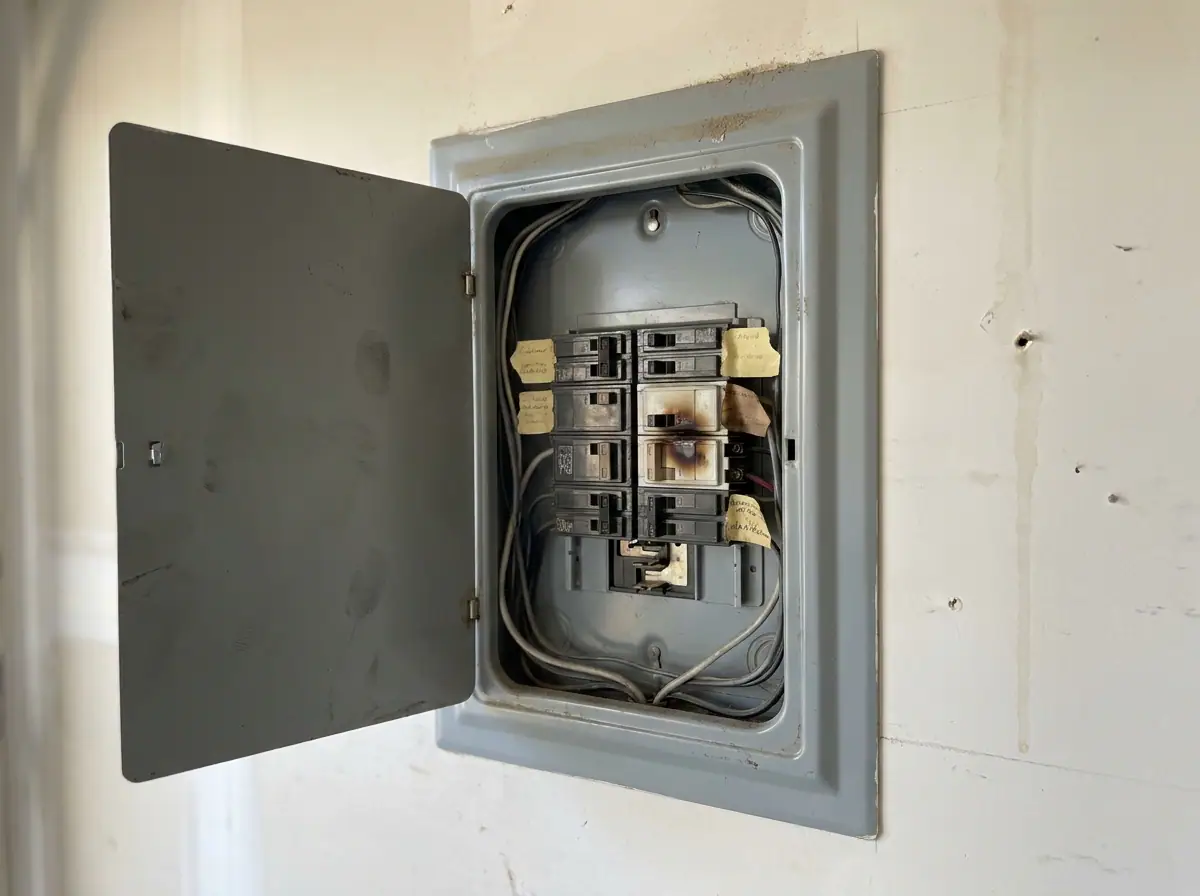
Your breaker box is overdue for a change if breakers trip constantly or will not reset, you still have a fuse box, the panel is a Federal Pacific (Stab-Lok) or Zinsco, it is 25 or more years old, lights dim when big appliances start, or you notice warmth, buzzing, scorch marks or a burning smell. Most modern Granbury homes need 200-amp service, while many older homes were built with 60 to 100 amps. A licensed electrician can assess the panel, pull the permit and usually complete a replacement in about a day.
Your electrical panel is the heart of your home's electrical system, yet most homeowners across Hood, Parker, Johnson and Somervell counties give it no attention until something goes wrong. Whether you live in an older home near the Granbury square or a newer build out in Tolar, this guide covers what to look for, what different panel problems mean, and what the upgrade actually involves.
What Does an Electrical Panel Actually Do?
Your panel (also called a breaker box, load center or service panel) receives power from the utility at the meter and distributes it through individual circuits to your outlets, lighting, appliances and HVAC equipment. Each circuit has a breaker (or, in older homes, a fuse) that trips and cuts power when the circuit draws more than it is rated for, preventing wiring from overheating and catching fire.
Panels are rated by amperage. Older homes in the Granbury area, particularly those built before the 1990s, often have 60-amp or 100-amp panels. That was fine when homes used far less electricity. Today's households run smart TVs, EV chargers, high-efficiency HVAC, home offices, multiple refrigerators and large kitchen appliances at once, and most modern homes need at least 150 to 200 amps. When a panel is outdated, overloaded or damaged, it can no longer protect your home reliably.
Signs Your Electrical Panel Needs to Be Replaced
1. Breakers Trip Frequently or Will Not Reset
An occasional trip after running too many appliances at once means the breaker is doing its job. A breaker that trips repeatedly on the same circuit, trips with no obvious cause, or will not stay in the reset position is a problem. It usually means the breaker is worn out, the circuit is consistently overloaded, or the whole panel lacks capacity. Frequent trips across multiple breakers suggest the entire panel is undersized. Rather than keep resetting it, have a licensed electrician check whether the trips call for a new circuit or a full upgrade. This is common in older homes where the kitchen or living room runs on a single circuit that was never updated as appliances were added.
2. Your Home Still Has a Fuse Box
Fuse boxes were standard in homes built before the 1960s. They are not inherently dangerous on their own, but they were designed for a fraction of today's load, they cannot be reset (a blown fuse has to be replaced), and they make it easy to install a fuse with a higher amp rating than the wiring can handle, which removes the protection entirely. Fuse-based systems may not meet current code, and many Texas insurers charge higher premiums or refuse to cover homes that still have them. A fuse-to-breaker conversion is one of the most impactful safety upgrades you can make.
3. Burning Smells, Scorch Marks, Warmth or Buzzing
A burning or plastic-like odor from the breaker box, scorch marks or discoloration around breakers, a panel or door that feels warm, or buzzing and crackling from inside the box all demand immediate attention. These can indicate overheating wires, loose connections or arcing (electricity jumping across a gap), which is a leading cause of electrical fires. If you can do so safely, turn off the main breaker or stop using the affected circuits, avoid running major appliances, and call a licensed electrician right away. Do not try to investigate or repair it yourself.
4. Rust, Corrosion or Visible Deterioration
Rust or corrosion on the panel box or bus bars points to moisture getting in. Combined with overheating connections and aging components, it creates fire hazards that worsen over time and will not resolve on their own.
5. Your Panel Is a Known Problem Brand
Federal Pacific Electric (FPE) panels with Stab-Lok breakers and Zinsco panels, widely installed from roughly the 1950s through the 1980s, have well-documented histories of breakers that may fail to trip during an overload, which removes circuit protection entirely. Many Texas insurers refuse to cover homes with these panels or require replacement before issuing a policy. Check the label inside the panel door: if you see Federal Pacific, Stab-Lok or Zinsco, replacement is strongly recommended regardless of age.
6. Lights Flicker or Dim When Appliances Start
If lights dim when the microwave, washer, dryer, dishwasher, hair dryer or air conditioner kicks on, the panel may be struggling to distribute power evenly. These voltage fluctuations can damage sensitive electronics over time. A single flickering bulb may just need replacing, but widespread dimming is worth investigating, and an electrician can tell whether the cause is the panel or faulty wiring elsewhere.
7. The Panel Is 25 or More Years Old
Most panels last 25 to 40 years. Age alone is not always a reason to replace, but it is a reason to inspect. Older panels may have breakers that no longer function reliably, internal corrosion or designs that do not meet current Texas electrical code. If your home is more than 20 to 25 years old and the panel has never been inspected, an evaluation costs very little and tells you exactly where you stand.
8. You Are Adding Major Loads or Remodeling
An EV charger (most need a dedicated 240-volt circuit with significant amperage), hot tub, pool, new HVAC or heat pump, electric range, whole-home generator, kitchen remodel, master suite, finished basement or garage, workshop or home addition all need dedicated circuits and extra capacity. An older 100-amp panel often lacks both the capacity and the open slots. Plan the upgrade before the project starts: it is almost always cheaper than discovering the limit midway, and it saves labor compared with a separate job later. See our remodel and circuit installation services.
9. Your Insurer Is Flagging the Panel
Texas insurers increasingly treat older panels, known problem brands and fuse boxes as high-risk. You may be asked for your panel's type and age during an application or renewal, and some carriers issue a notice requiring replacement within a set timeframe or they will cancel the policy. Many homeowners in Hood and Parker County have been through this, and it is straightforward to resolve with the right contractor.
Repair, Upgrade or Replace: How Electricians Decide
A licensed electrician looks at the panel's age, physical condition, wiring practices (such as aluminum wiring or double-tapped breakers), breaker performance and whether there is space for new circuits.
- Repair: replace individual faulty breakers, tighten loose connections or rewire a problem circuit when the panel is otherwise modern, has spare capacity and passes safety checks.
- Upgrade or replace: when the panel is obsolete, undersized for current or future loads, physically damaged, or shows overheating or corrosion.
- Intermediate: a subpanel to add circuits can be a reasonable short-term step, but it does not fix an unsafe or inadequate main panel.
How Many Amps Does Your Home Need?
A 200-amp panel is the standard for most modern single-family homes and usually covers central air, electric appliances and everyday electronics. Larger homes, extensive electric heating, multiple HVAC systems, a home workshop, EV charging, pools or a home-based business with heavy demand may justify 400-amp service, though that is less common in homes. A proper load calculation avoids installing a panel that is still too small (and paying for another upgrade later) or one that is oversized and adds cost without benefit.
It is also worth choosing a panel with more circuit positions than you need today. The cost difference between a 30-space and a 40-space panel is minimal, and the extra spaces give room for future additions such as solar panels, a hot tub or a workshop without another upgrade.
Modern panels also bring features older ones lack: arc-fault circuit interrupters (AFCI) protect against arcing that can cause fires, and ground-fault circuit interrupters (GFCI) prevent shock in wet locations. Current code requires these in specific applications, so an upgrade is a good time to bring the whole home up to standard.
What Happens During a Panel Upgrade
- Assessment and load calculation: the electrician evaluates the existing panel, your home's total load, the service entrance cable, the grounding system and code compliance, and asks about future plans (EV charger, solar, basement, workshop) so the panel is sized correctly from the start. This determines whether you need a like-for-like replacement or higher-amperage service.
- Permit: in Texas, panel replacements require a permit in most jurisdictions, and the work must meet the National Electrical Code (NEC) and Texas requirements, including grounding and bonding, wire sizing, breaker ratings and clearance around the panel. Revamped Electric pulls the permit and coordinates inspections with Hood County or the applicable municipality.
- Utility coordination: the utility (Oncor in most of the Granbury area) disconnects service at the meter for the replacement. Your electrician arranges this.
- Installation: the old panel is removed, the new one is mounted and grounded, and each circuit is reconnected, sized to match its wiring, clearly labeled and tested. Good installations include upgrading grounding if needed, proper torque on every connection, logical circuit layout and often whole-house surge protection. Unsafe wiring found along the way is flagged or addressed.
- Inspection and power restored: a local inspector verifies code compliance, then power is restored and the electrician does a final walkthrough.
Most residential replacements take four to eight hours, typically one day. Complex jobs, such as service upgrades, meter swaps, service mast replacement, trenching for underground service or rewiring aluminum conductors, can take a full day or more than one visit. Panel work is never a DIY project: the main service conductors entering your home carry live voltage that cannot be shut off from inside the house, and mistakes can cause electrocution, fire, code violations and insurance problems.
How to Prepare for a Panel Change
- Clear access to the panel by moving storage or obstructions in the garage, utility closet or basement.
- List critical circuits (refrigerator, medical equipment, sump pump, HVAC) so your electrician can minimize downtime or arrange temporary power.
- Plan for an outage of several hours and schedule it when reduced power will not disrupt essential equipment.
- Ask for a written scope, timeline and permit information before work begins.
What Does a Panel Upgrade Cost?
Price depends on panel size and service capacity, the condition of existing wiring, whether extra circuits or service entrance work are needed, and local permit fees. Ballpark ranges quoted in the Granbury and Fort Worth area:
| Work | Typical range |
|---|---|
| Breaker replacement or minor repair | $100 to $400 per breaker or repair |
| Panel replacement, 100 to 150 amp | $800 to $2,000 |
| Panel replacement, 200-amp service upgrade | $1,500 to $4,000 or more (depends on meter, service mast, trenching for underground service and utility coordination) |
These are ballpark figures only. Always get a written estimate from a licensed professional that includes permits, materials and labor. Revamped Electric prices transparently: no upsells, no padded quotes, and you know what you are paying before work begins. Whatever the price, it is far less than the cost of an electrical fire, a denied insurance claim or years of compounding problems from a failing panel.
Why an Upgrade Pays Off
- Safety: outdated or overloaded panels are among the leading contributors to residential electrical fires. The National Fire Protection Association has consistently found electrical failures or malfunctions among the top causes of U.S. home fires, and the Electrical Safety Foundation International reports electrical fires account for tens of thousands of house fires each year.
- Insurance: a modern panel can lower premiums in many cases, and insurers may deny claims involving unpermitted electrical modifications.
- Resale: inspectors flag old panels, and an outdated or unpermitted panel can complicate financing, delay closing or become a costly negotiating point. A modern, code-compliant panel is a selling point.
- Room to grow: a properly sized panel handles future additions without another overhaul.
- Summer reliability: North Texas summers keep HVAC running at full capacity for months, and marginal panels often fail during peak cooling season. Get ahead of it before summer.
Pairing a Panel Upgrade With Other Work
With the electrician on site and the system open, it is often more cost-effective to add dedicated circuits for high-demand appliances, install whole-home surge protection, fix faulty wiring that has been flagged, add an EV charger circuit or upgrade outdoor lighting at the same time. Homes on acreage around Tolar, Stephenville and Mineral Wells often have outbuildings, workshops or barns that need subpanels or dedicated circuits, which our team handles regularly. We also work with builders on new construction so panels are sized for current needs and future growth.
Keeping Your New Panel Healthy
- Keep the panel area clear and dry, and do not store flammable items nearby.
- Keep breaker labels clear so future troubleshooting is faster and safer.
- Schedule periodic inspections, especially after adding major appliances.
- If you notice new sounds, warmth or odors from the panel, shut off the affected circuits and call a licensed electrician immediately.
Choosing an Electrician for Panel Work
Ask any contractor:
- Are you licensed and insured in Texas? Ask for the license number and proof of insurance.
- Do you handle permits and inspections?
- Can you provide a written estimate and timeline covering labor, parts and possible extra costs?
- Do you warranty parts and labor?
- Can you explain future-proofing options such as spare circuits, EV charger readiness or a larger main?
Be cautious of anyone who suggests skipping the permit or quotes without first assessing your home. Revamped Electric is veteran-owned and based in Granbury. Owner Austin Barrett served in the US Navy aboard the USS Jason Dunham and brings that discipline and attention to detail to every panel change, and electrician Nicholas Torres has deep roots in Granbury and hands-on experience in residential, commercial and new construction work. You get a local team, not a rotating crew from a national chain. Learn more about our panel changes and full list of services.
Frequently Asked Questions
How long does an electrical panel replacement take?
Most residential replacements take four to eight hours, usually one day. Service upgrades, meter swaps or underground service work can take longer or need more than one visit.
Do I need a permit to replace my panel in Texas?
Yes, in most jurisdictions, followed by a local inspection. A reputable electrician pulls the permit and schedules the inspection for you.
How many amps does my home need?
Most modern homes are well served by 200 amps. Large homes or properties with heavy loads such as EV charging, pools, workshops or multiple HVAC systems may need 400-amp service.
Are Federal Pacific and Zinsco panels dangerous?
Both have documented problems with breakers that may not trip during an overload. Replacement is strongly recommended regardless of age, and many insurers require it.
Should I replace my fuse box?
Yes. Fuse boxes were not designed for modern loads, are easy to fit with the wrong fuse, may not meet code and can make a home hard to insure.
Can I replace a panel myself?
No. The service conductors carry live voltage that cannot be shut off from inside the house, and unlicensed work can void insurance and cause problems when you sell.
Can a subpanel solve my capacity problem?
Sometimes, as a short-term way to add circuits, but it does not fix a main panel that is unsafe or inadequate.
If your panel shows any of these warning signs, or you simply have not had it looked at in years, Revamped Electric serves Granbury, Tolar, Weatherford, Aledo, Stephenville, Mineral Wells, Benbrook, Hudson Oaks, West Fort Worth and the surrounding communities. Call 817-677-0036 or request a quote for an honest assessment with no pressure and no surprises.