
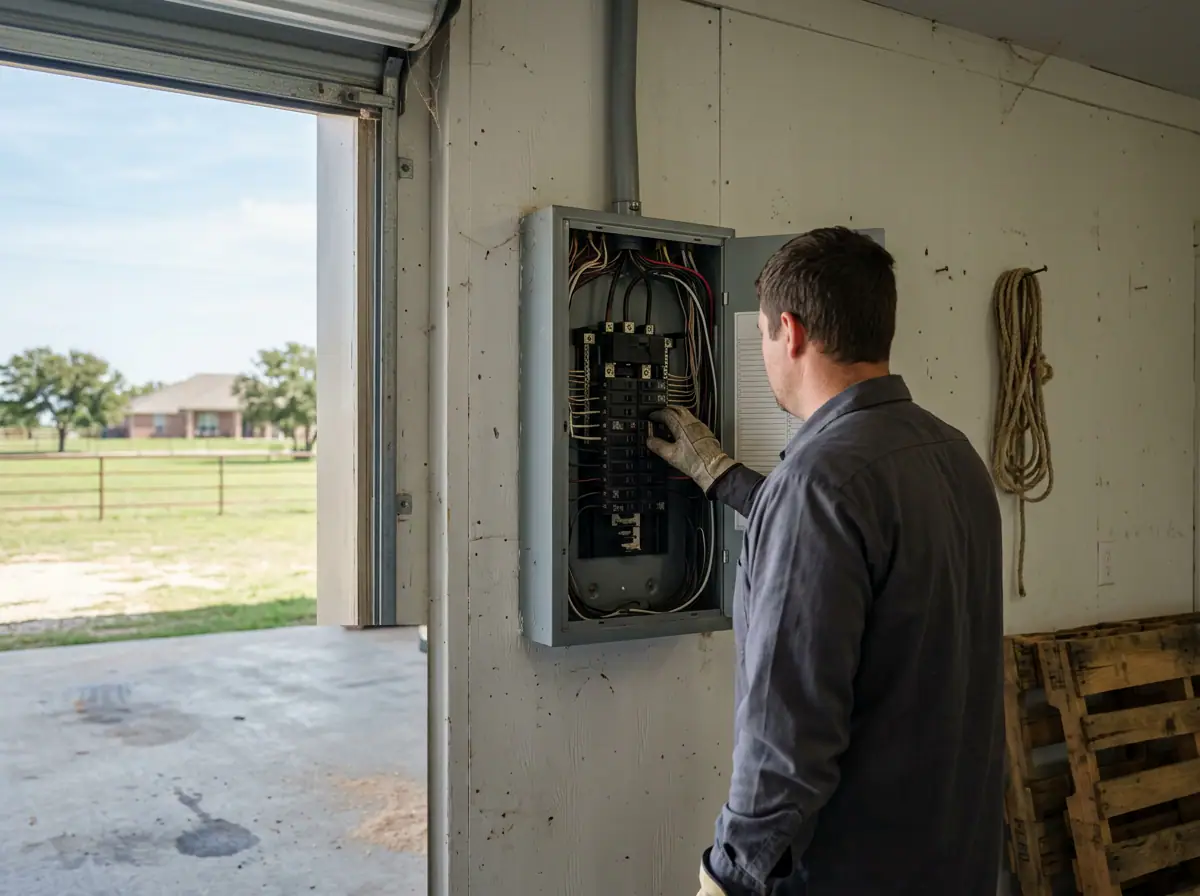
When the power acts up at a home outside town, you can't borrow a neighbor's breaker box or wait for a building maintenance crew. You need electrical repair in Cresson, TX from someone who understands how properties out here are actually wired: acreage homes with a shop out back, newer builds in growing subdivisions, and older rural houses that have been added onto several times. At Revamped Electric, we are a veteran-owned electrical contractor based in Granbury, and we diagnose and fix these problems across Hood County, Parker County and Johnson County. This guide walks through what we see, what causes it, what you can safely check yourself, and when a repair is really a sign of something bigger.
Electrical Repair in Cresson, TX: The Problems Homeowners Call About Most
Cresson sits where Hood, Parker and Johnson counties meet, with US Highway 377 and State Highway 171 tying it to the surrounding towns. Homes here range from custom builds on several acres to older farmhouses. The symptoms are familiar, but the causes often depend on the property.
Breakers that keep tripping
A circuit breaker that trips is doing its job: something on that circuit is overloaded, shorted or leaking current to ground. If your breaker keeps tripping in Cresson only during the hottest months, the air conditioner and other heavy loads are the first suspects. Heat also makes loose connections worse, so a connection that is fine in March can trip in August. The fix might be a worn breaker, a failing appliance, a shared circuit that needs to be split, or a bad connection inside a box.
Dead outlets and switches
An outlet not working in Cresson, TX is usually one of a few things: a tripped GFCI somewhere else on the circuit, a loose "backstab" connection, a failed receptacle, or a wire that has come loose upstream and killed everything after it. If several outlets in a room died at once, the cause is almost always upstream of the dead outlets, not the outlets themselves.
Flickering lights
One flickering fixture is often just a bulb, dimmer or socket. Lights that flicker or dim throughout the house when the AC or well pump starts point to a bigger issue such as a loose connection at the panel or a problem with the service. That deserves prompt attention.
Warm or buzzing outlets and switches
A plug that is slightly warm under a heavy load can be normal. An outlet or switch plate that is hot, discolored, buzzing, crackling or smelling of burned plastic is not. Those are signs of a failing connection, and a loose connection creates heat. Stop using that circuit and call us.
Acreage Homes, Detached Shops and Barns: Repairs on Long Feeders
Many Cresson properties have power running a long way from the house to a shop, barn, well house or guest quarters. Those runs create problems you rarely see in a typical subdivision lot.
- Voltage drop: When a feeder is long or undersized, equipment at the far end gets less voltage than it should. Welders, compressors and well pumps can struggle, trip breakers or run hot.
- Damaged underground feeders: Trenching for a fence, a pond, a water line or a driveway can nick buried cable or conduit. Water getting into conduit over time can also break down a connection and cause intermittent trips or a total loss at the outbuilding.
- Overhead run issues: Weather, tree limbs and livestock-related wear can damage overhead feeders and their attachments.
- Subpanel and grounding problems: A detached building needs a properly installed subpanel and correct grounding. Shops that were wired over the years by different people often have mismatched or missing pieces.
- Well pump circuits: If the water stops, the problem may be the pump, the pressure switch, the breaker or the wiring between them. Sorting out which one matters before anything gets replaced.
If your shop loses power but the house is fine, the fault is somewhere in the feeder, the disconnect or the subpanel. We trace it step by step rather than guessing. Our guide to loss of power repair explains how we approach it.
Newer Builds Around Cresson: When It Is a Workmanship Issue
New homes are not immune to electrical trouble. In a recently built home, the problems tend to be about how the work was done rather than age. Common examples include:
- Loose connections at receptacles, switches or breakers that were not fully tightened during construction and have loosened as the house settles and temperatures swing.
- Overloaded circuits where too many outlets, lights or appliances were put on one breaker.
- GFCI and AFCI nuisance trips caused by shared neutrals, miswired devices or a connected appliance that does not play well with the protection. Modern code requires GFCI and AFCI protection in many areas of the home, and these devices are sensitive to wiring errors.
- Unfinished or mislabeled work such as an unlabeled panel, a missing cover plate or a device that was never connected correctly.
If a house is only a few years old and you have repeated trips or dead devices, ask whether it is a workmanship problem. Depending on your builder's warranty, you may have options before paying for a repair yourself. We can document what we find. If you are planning a build, see our new build electrical services in Cresson. For signs of poor work in general, our page on faulty wiring is a good place to start.
Safe Checks Before You Call, and What Never to Attempt
A few simple checks can tell you a lot, and give us a head start. For a longer walk-through, see our electrical troubleshooting guide.
Checks that are safe for homeowners
- Reset a tripped breaker once. Push it fully to OFF, then back to ON. If it trips again right away, leave it off.
- Test your GFCIs. Look for GFCI outlets in bathrooms, the kitchen, the garage, outdoors and any outbuilding. Press the RESET button. A single tripped GFCI can kill several outlets downstream.
- Figure out whole-house or partial outage. Look at your neighbors and your utility's outage information. If the whole area is dark, it is not your wiring. If only part of your house is out, or half the lights are dim and the other half bright, the problem is on your side.
- Unplug devices from the affected circuit and see if the problem changes.
What never to attempt
- Do not remove the panel cover or touch anything inside it.
- Do not keep resetting a breaker that trips again.
- Do not tape over, cap or twist together wires to "make it work."
- Do not use a circuit with a burning smell, scorch marks or sparking.
- Do not go near a panel or outlet while standing in water, including a flooded shop.
If you see smoke or flames, leave and call 911. For other urgent situations, read our guide on what to do before the electrician arrives.
When a Repair Is Really a Bigger Problem
Most repairs are exactly that: find the fault, fix it, done. Sometimes, though, the repair points to something larger.
- Panel issues: Frequent trips across multiple circuits, a hot or buzzing panel, rust, a breaker that will not stay on, or a panel brand with a known history all suggest a panel upgrade may be in order. We cover this for acreage homes on our Cresson panel upgrade page.
- Failing wiring: If repairs keep uncovering brittle insulation, scorched wires, or splices hidden in places they should not be, the wiring itself may need replacement. Our page on faulty wiring explains the warning signs.
- Not enough outlets: If you rely on power strips and extension cords because there are too few outlets, adding proper outlet installation is safer than patching the problem.
- Unknown history: If you bought an older rural home or a property that has been modified over the years, an inspection can show what else is lurking.
How a Repair Visit Works, and What Drives the Cost
Our process is simple and designed to keep you informed.
- Diagnosis. We ask what you have noticed, then test to find the actual cause instead of swapping parts.
- Explanation. Before we start fixing anything, we tell you what we found, what the fix involves and why.
- Licensed work. Repairs are done by a TDLR licensed electrician working to code. Revamped Electric holds Texas Electrical Contractor License 40771.
- Cleanup. We test our work, leave the area tidy and make sure you understand what was done.
We do not promise a price or timeline before we see the problem, because repairs vary. What typically affects cost:
- Access: Is the problem easy to reach, or is it in a finished wall, an attic or a buried run to a barn?
- Diagnosis time: Intermittent faults and long feeders take longer to track down than an obviously failed outlet.
- Parts: A standard receptacle is different from a breaker, a disconnect or a length of feeder cable.
- Code corrections found along the way: If we open something up and find an unsafe condition, we will tell you and let you decide how to handle it.
Serving Cresson and the Communities Around It
We are based in Granbury and serve Cresson along with Tolar, Weatherford, Stephenville and nearby areas in Hood, Parker and Johnson counties. Austin Barrett, a U.S. Navy veteran, owns the company, and Nick Torres, a Granbury native with experience in new construction and service calls, is part of the team. Being veteran-owned means we hold ourselves to a high standard of discipline and honesty. You can learn more about our team.
Cresson Electrical Repair FAQ
Why does my breaker trip only in summer?
Summer brings heavier air conditioning loads, and heat makes marginal connections and aging breakers more likely to fail. An overloaded or shared circuit that is fine in cooler months can trip when the AC is running hard. If it keeps happening, have it checked.
Is a warm outlet an emergency?
Slightly warm under a heavy load can be normal. If the outlet is hot, discolored, buzzing, sparking or smells like burning, stop using it, turn off the breaker if it is safe to do so, and call an electrician right away. If there is smoke, call 911.
Why does only part of my house have power?
It could be a tripped breaker, a GFCI that tripped, or a problem with the service or panel. If some lights are dim and others bright, treat it as urgent and call us.
Why did the power go out at my shop but not the house?
The problem is likely in the feeder, a disconnect or the subpanel serving the shop. Check for a tripped breaker at both the house panel and the shop panel, then call us if the power does not return.
My home is newer. Why am I having electrical problems?
Newer homes can have loose connections, overloaded circuits or GFCI and AFCI nuisance trips caused by wiring errors. Some of these are workmanship issues that may be worth raising with your builder.
Get a Licensed, Veteran-Owned Electrician Out to Your Cresson Home
Whether the trouble is at the house, the shop or the barn, you should not have to guess what is wrong. Call Revamped Electric at 817-677-0036 or book through our contact page and we will diagnose the problem at your Cresson home, explain the fix and get your power working safely again.