

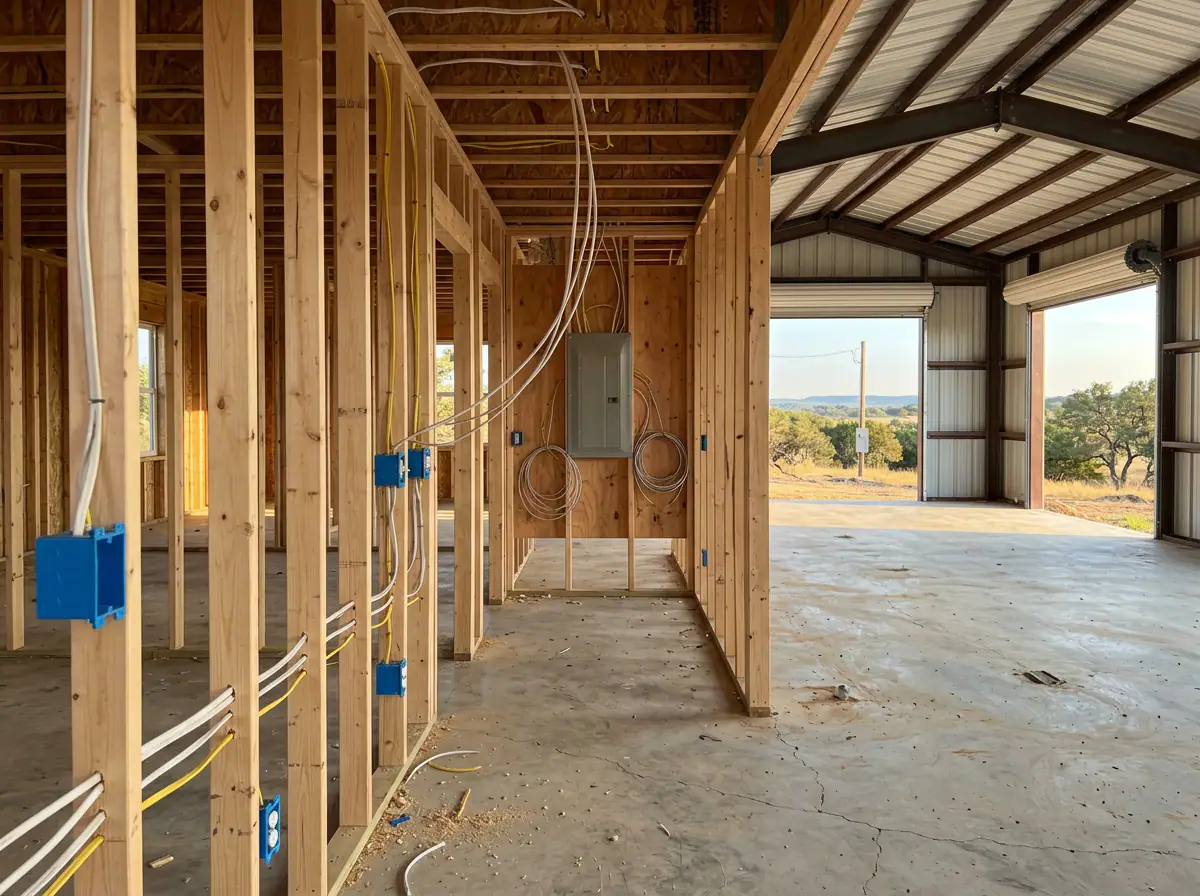
Building on open acreage near US Highway 377 is a different job than building in a subdivision. You are not just picking finishes. You are deciding where the power comes from, how far it has to travel, and how much of it your home, shop and future plans will need. Getting new build electrical services in Cresson, TX right means making those decisions early, while the walls are open and changes are cheap.
This guide walks owner-builders and custom-home buyers through every electrical stage of a new build, from the temporary power pole to final trim. It also covers the choices that are painful to fix after drywall: panel size, EV-ready and generator-ready circuits, and power for a shop or barndominium.
New Build Electrical Services in Cresson, TX: Who We Build For
Cresson sits where Hood, Johnson and Parker counties meet, so the projects out here tend to be rural and varied. Most of the new construction work we see falls into a few groups:
- Custom homes on acreage, often with large HVAC systems, big kitchens and covered outdoor living areas.
- Barndominiums that combine living space and a shop under one metal roof.
- Detached shops and outbuildings that need their own subpanel, lighting and 240-volt equipment circuits.
- Additions and guest houses that need power planned around what is already on the property.
Revamped Electric is veteran-owned and based in Granbury. Austin Barrett, a U.S. Navy veteran who served aboard the USS Jason Dunham, runs the company with co-owner Nick Torres, who specializes in new construction and service calls. You can read more about our team and see our full new construction electrical services.
The New Build Electrical Sequence, Step by Step
Knowing the order of work helps you schedule, budget and spot problems early. Here is how a typical new build moves along.
1. Temporary power pole
Before framing really gets going, your builder and subcontractors need power for saws, compressors and lighting. A temporary power pole provides that. On rural lots, how soon you can get one depends on the utility provider serving your parcel and how far the lines have to be extended, so start that conversation early.
2. Service entrance and meter base
The service entrance is the heavy-duty connection between the utility and your home. It includes the meter base, the main disconnect and the grounding system. The location matters. On acreage, the distance from the utility connection to your building site can shape both the layout and the cost.
3. Rough-in
Once the framing is up and the roof is on, we run cable, set boxes and wire circuits for outlets, switches, lighting, appliances and HVAC. This is the stage where your plans turn into reality, and the last chance to move a switch or add an outlet without opening finished walls.
4. Inspections
A rough-in inspection happens before insulation and drywall cover the work. The inspector checks wiring methods, box fill, protection devices and grounding against the National Electrical Code (NEC) and local requirements. Passing it clears the way for the next trades.
5. Trim-out and final
After drywall and paint, we install devices, fixtures, ceiling fans, the panel interior and any specialty equipment. A final inspection confirms everything is safe and ready for permanent power.
Permits and Inspections Around Cresson
Cresson spans three counties, and requirements can differ depending on whether your property is inside city limits or in an unincorporated part of Hood, Johnson or Parker County. Who issues the permit, who inspects the work, and which edition of the NEC applies can all vary with your exact address.
Our approach is simple: we confirm the correct jurisdiction for your parcel before work starts, then build the schedule around it. Revamped Electric holds Texas Electrical Contractor License 40771, and electrical contractors in Texas are licensed through the Texas Department of Licensing and Regulation (TDLR). For a look at how permitting works on nearby projects, see our guide to electrical permits and code compliance.
Sizing the Service and Panel for Modern Loads
A 200-amp service is a common starting point for a new home, but common is not the same as right for your property. Size the service around what you will actually run:
- HVAC: Larger homes and long Texas summers mean bigger air conditioning loads, sometimes with multiple units.
- Well pump: If your property is on a well rather than public water, the pump needs its own properly sized circuit.
- Kitchen and laundry: Ranges, ovens, dryers and dishwashers all need dedicated circuits. Our kitchen electrical planning guide covers what to expect.
- Shop or barn: Welders, compressors and lifts can add serious demand.
- EV charging: A Level 2 charger is a significant continuous load.
If you are building a larger home or a home plus shop, ask about a higher-capacity main panel or a main panel with a subpanel in the outbuilding. Leaving open breaker spaces now costs far less than replacing a panel later.
Decisions to Make Before the Drywall Goes Up
These are the items we most often wish owners had settled earlier. Each one is easy during rough-in and expensive afterward.
EV-ready circuits
You may not own an electric vehicle today, but a garage that is wired for one adds flexibility. At minimum, plan the panel capacity and a conduit path to the garage. We cover the details in our guide to preparing your home for an EV charger.
Generator inlet or transfer switch prep
Rural power can be less predictable during storms. Planning for a transfer switch or generator inlet during the build lets you add a portable or standby generator later without rewiring your panel. Read more in our guide to generator installation and transfer switches.
Whole-house surge protection
Modern homes are full of electronics and expensive HVAC equipment. A whole-house surge protector installed at the panel is easiest to add while the panel is being set up. Learn how it works in our whole house surge protector guide.
Lighting layout
Where you put recessed lights, pendants, under-cabinet lighting and exterior fixtures affects how the house feels every day. Decide on switch locations, dimmers and fixture boxes before rough-in. Our home lighting design guide can help you plan.
Protection devices and extra outlets
The NEC requires AFCI and GFCI protection in many areas of a new home, and we install it to current code. Beyond code, think about outdoor outlets, garage and patio receptacles, and extra circuits for a home office.
Barndominium and Metal Building Wiring
A barndominium electrician in Cresson faces challenges that stick-built homes do not. Metal framing changes how cable is run and protected. Slab-on-grade construction means anything buried in concrete has to be planned precisely before the pour. And with living space and a shop sharing one structure, you have to think about separate loads, separate panels and separate lighting zones.
Key points to settle early:
- Where the main panel and any subpanel will sit.
- Conduit locations under the slab for floor outlets, shop equipment and future needs.
- Shop equipment, such as welders, compressors and lifts, and the circuits each one needs.
- Lighting for tall ceilings and open spans.
- How power will reach any outbuildings later.
We go deeper on this in our guide to barndominium and shop wiring.
Working With Your Builder: Plans, Change Orders and Walkthroughs
Good electrical work starts on paper. Send us your plans as early as you can, ideally before the builder finalizes the framing. We will mark up outlet placement, panel location, circuit needs and special loads so everyone works from the same picture.
A few habits keep a build on track:
- Do a pre-rough-in walkthrough with the electrician and builder. Walk the framed house and point to where things go.
- Put changes in writing. A moved range, an added shop circuit or a new light location should be documented as a change order, not a hallway conversation.
- Walk the job again before trim-out to confirm switch heights, fixture locations and device types.
For a broader look at how we handle larger projects, see our overview of an electrical contractor for new construction.
What Drives the Cost of New Build Electrical
We do not quote a number without seeing your plans, because the range between two homes can be wide. These are the factors that move the price most:
- Square footage: More space means more wire, boxes, devices and labor.
- Service size: A larger service and panel cost more than a standard setup.
- Distance from the utility: Long runs across acreage add materials, trenching and labor.
- Number of circuits: Dedicated circuits for appliances, a well pump, a shop or EV charging add up.
- Finishes: Specialty lighting, smart switches, dimmers and designer fixtures change the total.
Our goal is a clear, upfront quote you can compare against your budget, with no surprises at trim-out.
Cresson New Build Electrical FAQ
Are you licensed to do new construction electrical in Texas?
Yes. Revamped Electric holds Texas Electrical Contractor License 40771, issued through TDLR.
Do you work with owner-builders?
Yes. We work with owner-builders as well as general contractors. We will talk through who is responsible for permits and inspections for your specific property before any work begins.
What affects the timeline for a new build electrical job?
The biggest drivers are the build schedule, utility scheduling for the temporary pole and permanent service, inspection availability, and any plan changes made during construction.
What areas do you serve?
We serve Cresson and the surrounding area across Hood, Johnson and Parker counties, along with Granbury, Tolar, Weatherford, Stephenville and nearby North Texas communities.
Plan It Once, Wire It Right
The best new builds are the ones where the electrical plan was settled before the first wall went up. Panel capacity, EV and generator circuits, surge protection and shop power are all far easier to build in than to bolt on later.
Send us your plans or call 817-677-0036 to book a pre-construction walkthrough with Austin or Nick before rough-in. We will help you plan it once and wire it right. You can also contact us online to get started.