
If you live around Lake Granbury, you know how fast a North Texas storm can roll in. A line of thunderstorms passes, the lights flicker once, and a week later your AC control board is dead or the smart TV will not turn on. Whole house surge protector installation in Granbury, TX is the fix most homeowners never think about until after the damage is done. It protects the whole electrical system from one spot: your main electrical panel.
This guide explains what a panel-mounted surge protector does and what it does not do. It also covers why it only works on a properly grounded system, and when it is required instead of optional. We wrote it from the point of view of a Hood County electrician who sees these installs, and the grounding problems behind them, up close.
What a Whole House Surge Protector Is and Where It Mounts
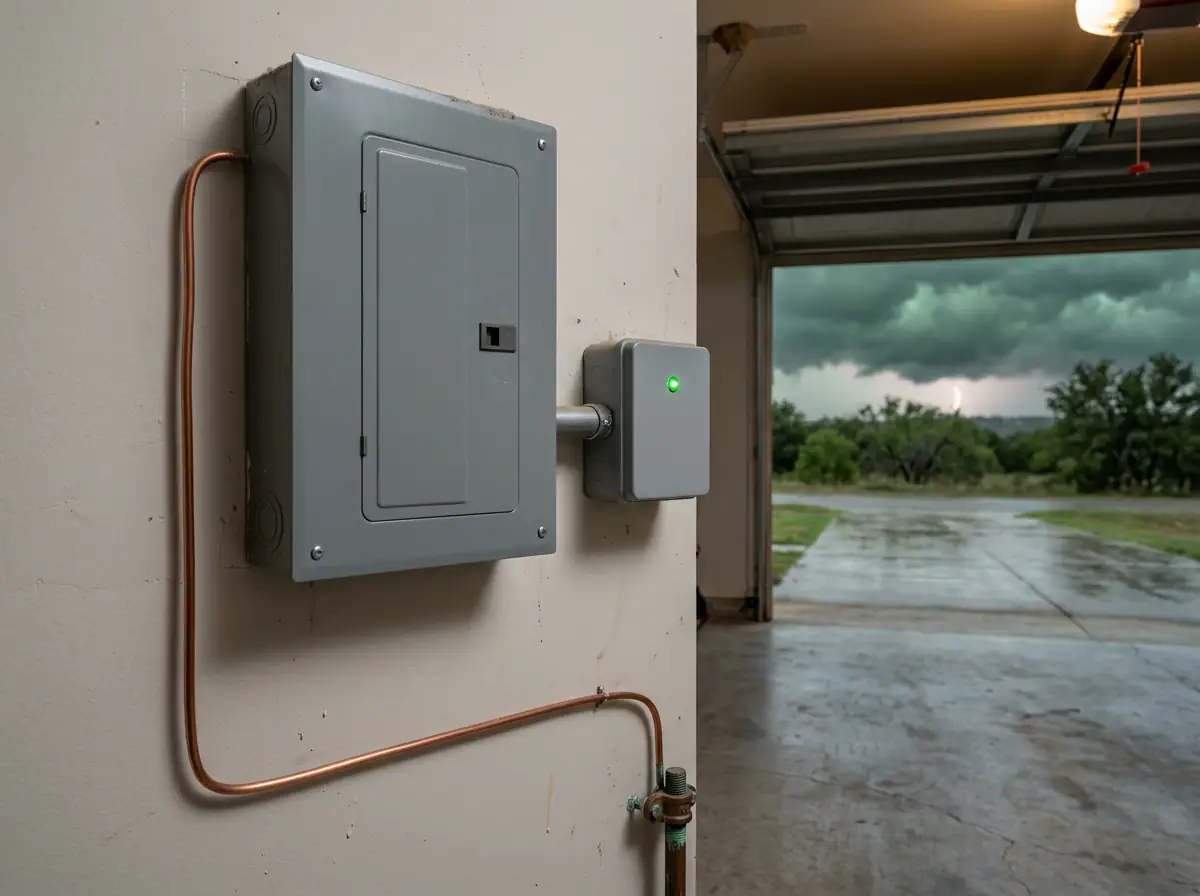
A whole home surge protector is a surge protective device (SPD). It mounts at or next to your main electrical panel, also called the breaker box. When a voltage spike comes in on the service wiring, the device diverts the excess energy toward ground before it spreads through your branch circuits. That is why people call it a surge protection device for the electrical panel: it sits at the front door of your house's wiring and deals with the surge before it reaches anything else.
A plug-in power strip with surge protection does something different. It protects only what is plugged into it, and only against surges that reach that outlet. It is a useful second layer for computers, TVs and gaming gear. It does nothing for hardwired equipment like your HVAC system, water heater, well pump or EV charger, because those never plug into a strip.
Homes need both layers. The panel-mounted device takes the big hit at the service. The plug-in strips catch the smaller leftovers and the surges created inside the house. Think of it like a storm door and a screen door: neither replaces the other.
What Causes Surges in a Granbury Home
Most people blame lightning, and North Texas spring storms do deliver plenty of it. But lightning is only one source. Surges in a Hood County home usually come from three places:
- Storms and lightning. A nearby strike can push a spike onto power lines and into your service, even if it never hits your house.
- Utility switching. When the utility reroutes power, clears a fault or restores service after an outage, the grid can send brief spikes down the line.
- Motors cycling inside your house. AC compressors, well pumps, pool pumps and garage tools all create small surges every time they start and stop. These are the ones that slowly wear out electronics over the years.
If you are out in Tolar, Cresson or rural parts of Hood County, long overhead service runs and well pumps make the case for protection even stronger. The same goes for homes around Stephenville and Weatherford, where open ground and storm exposure are part of life.
What a Panel Mounted Surge Protector Protects (and What It Does Not)
A whole house device helps protect the sensitive electronics built into modern equipment:
- HVAC compressor and control board, which are expensive and surge-sensitive
- Refrigerators, ranges, washers and other appliances with electronic controls
- EV chargers and the electronics inside the vehicle's charging system
- Smart thermostats, doorbells, routers and other smart devices
- Well pump controls and pool equipment
Be honest with yourself about the limits. A surge protector is not a guarantee against a direct lightning strike. A direct hit carries far more energy than any residential device is built to absorb. What the device does is reduce risk and take the wear from everyday surges. If anyone promises you total protection from lightning, be skeptical.
Why Grounding and Bonding Come First
This is the part most local service pages skip. A surge protector does not destroy a surge. It sends the surge to ground. If your grounding electrode system is missing, corroded, loose or poorly connected, the device has nowhere good to send that energy. You can install the best device on the market on a bad ground and get a fraction of the protection you paid for.
That is why we check grounding and bonding before we mount anything. We look at the connection to the grounding electrode, the bonding at the panel and the condition of the conductors. On older homes around Granbury, we sometimes find a ground clamp that has corroded, a ground wire that was cut or an electrode that was never installed properly. If you want the full background, read our explainer on electrical grounding and bonding.
Is a Whole House Surge Protector Required? Code Context
Many homeowners ask, "do I need a whole house surge protector?" For a lot of existing homes, it is a smart upgrade rather than a mandate. For new work, the answer is changing.
The 2020 National Electrical Code (NEC) introduced Article 230.67, which requires surge protection on dwelling unit services. The rule calls for a Type 1 or Type 2 SPD installed at the service equipment or immediately adjacent to it. It also applies when service equipment is replaced, which means a panel replacement or service upgrade can trigger it.
Here is the important caveat. Which edition of the NEC applies depends on what your local jurisdiction has adopted and enforces, and that can differ between cities and counties. Before we state a requirement on any job, we confirm what the City of Granbury or Hood County is currently enforcing for that address. Do not assume your project falls one way or the other. Ask us and we will check it before the work starts.
In practice, it makes sense to include surge protection whenever we are already in the panel. If you are looking at a panel replacement or upgrade, or wondering whether your breaker box is due, our guide on signs your breaker box is overdue for a change is a good place to start. For builders and homeowners planning a new build, surge protection belongs in the original plan, not as an afterthought.
Choosing a Device: Type 1, Type 2, UL 1449 and kA Ratings
You do not need to become an expert, but a few terms help you ask good questions:
- Type 1 vs Type 2. Both are allowed under 230.67. Type 1 devices can be connected on the line side of the main disconnect. Type 2 devices connect on the load side. Which fits depends on your panel and how it is set up.
- UL 1449 listing. This is the safety standard for surge protective devices. A device without a UL 1449 listing is not something we would put on your panel.
- Surge current rating in kA. This shows how much surge current the device is designed to handle. A higher rating generally means more capacity, but it is only one factor.
- Status indicator lights. A good device shows you whether its protection is still active. This matters more than it sounds, as we explain in the FAQ below.
What Drives the Price of Surge Protection
We do not quote prices in a blog post because every panel is different, but here is what moves the number:
- Device type. Different ratings and designs cost different amounts.
- Panel space and condition. A device needs a place to mount and connect. A crowded or damaged panel adds work.
- Grounding corrections. If the grounding or bonding needs repair first, that is added to the job.
- Timing. Adding it during a panel change or new build is usually more efficient than a separate standalone visit.
As with all our work, you get an upfront estimate before we start. No surprises.
How Surge Protector Installation Works with Revamped Electric
Revamped Electric is a veteran-owned electrical contractor based in Granbury. Austin Barrett, a U.S. Navy veteran, owns the company, and co-owner Nick Torres is a Granbury native with deep experience in new construction and service calls. Here is how a typical whole home surge protection visit goes:
1. Inspection
We look at your main panel, its condition, available space and any signs of heat, corrosion or past damage.
2. Grounding and bonding check
We verify that the grounding electrode and bonding connections are sound before installing anything. If something is wrong, we explain it plainly and show you what we found.
3. Installation
We mount the SPD at or next to the panel with short, direct leads and proper connections, following the manufacturer's instructions and the code that applies to your address.
4. Testing
We confirm the device is powered and its status indicator shows it is working, then walk you through what that light means.
Whole House Surge Protector FAQ
Do I need one if I already have power strips?
Yes. Power strips only protect what is plugged into them and do nothing for hardwired equipment like your HVAC, water heater or well pump. A panel-mounted device and plug-in strips work as two layers.
Will it work on an older panel or a Federal Pacific panel?
It depends on the panel's condition and whether there is room and a safe way to connect. A Federal Pacific panel is a separate concern, and in many cases replacement is the better plan. We evaluate it on site and tell you honestly.
Can it be added to my new build?
Yes, and it is the easiest time to do it. We can include surge protection in the original panel installation so there is no second trip.
How do I know it is still working?
Check the status indicator light on the device. Surge protectors wear out after absorbing surges, and the light tells you if protection is still active. If it is off, flashing an alert or showing a fault, call us. A heavy storm season is a good time to look.
Protect Your Panel Before the Next Storm
The best time to add surge protection is before the next round of North Texas lightning, not after your HVAC board fails. If you have an EV charger or are planning one, surge protection is even more worthwhile, and our guide on EV charger installation in Granbury covers the rest of the setup. You can also learn more about our team and how we work.
Call Revamped Electric at 817-677-0036 or use our contact page to book a surge protection and grounding check. If you are already planning a panel change or a new build, we can add the surge protector during that same visit, so you avoid a second trip.