

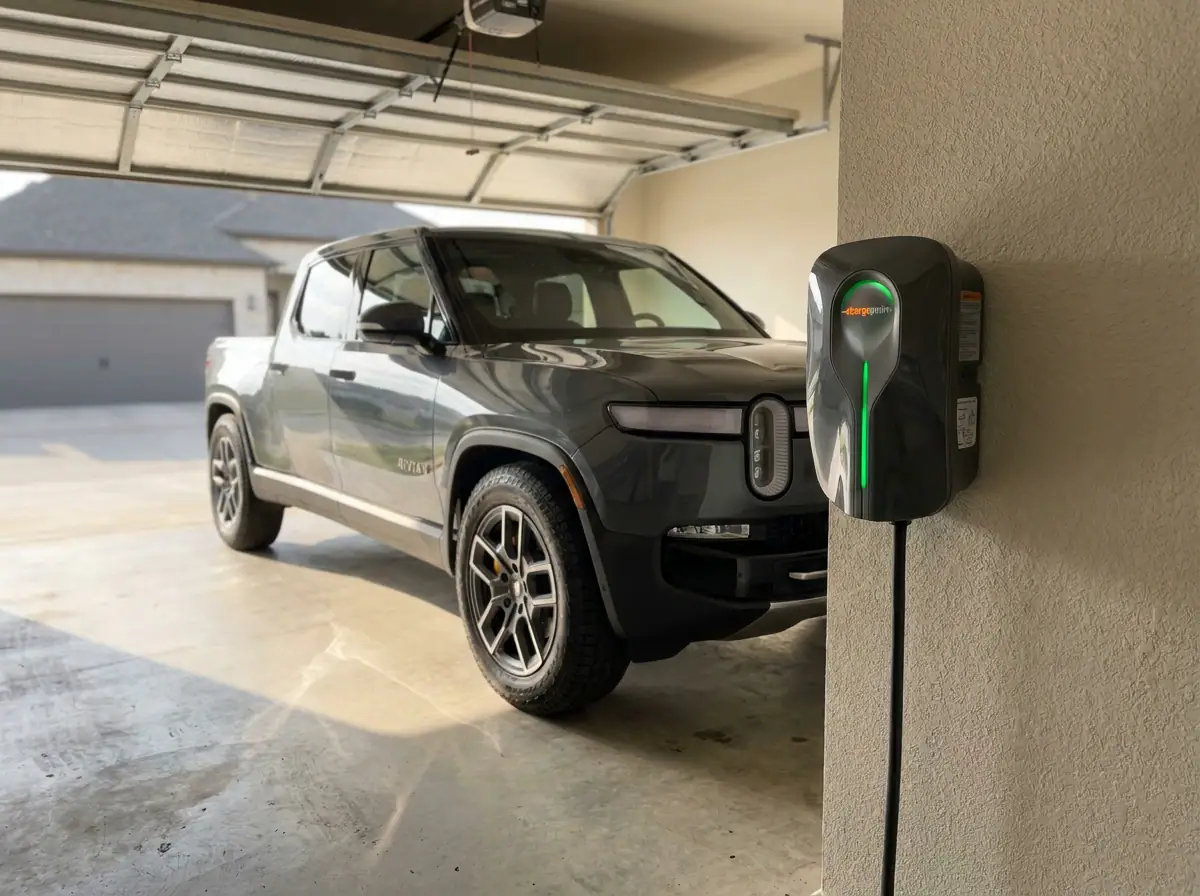
Most Granbury homeowners who go electric need a Level 2 charger on a dedicated 240-volt circuit, usually 40 or 50 amps, installed by a licensed electrician with a permit. The first step is a panel assessment: if your panel lacks capacity or open breaker slots, it may need an upgrade (often to 200-amp service) or a load management system before the charger goes in. With the panel confirmed, a straightforward garage installation can often be finished in a single visit.
This guide covers charging levels, what your panel needs, where to put the charger, how installation works, costs and incentives, and how to keep the system safe for homeowners across Granbury and Hood County.
Level 1 vs. Level 2 charging: what is the difference?
Level 1 charging
Every EV comes with a Level 1 cord that plugs into a standard 120-volt household outlet, the kind used for lamps and phone chargers. It needs no special installation, but it is slow: roughly 3 to 5 miles of range per hour. If you drive 40 miles a day, that is 8 to 12 hours just to recover your commute, and a fully depleted battery (for example a 250-mile battery) can take 40 to 50 hours or more. Level 1 works for plug-in hybrids with small batteries and for light drivers, but for most full-battery EV owners it quickly becomes a bottleneck.
Level 2 charging
Level 2 runs on a 240-volt circuit, the same voltage as your electric dryer, oven or range. A Level 2 charger (also called EVSE, Electric Vehicle Supply Equipment) adds roughly 10 to 30 miles of range per hour, most often 20 to 30, depending on the vehicle and charger. Most EVs fully recharge overnight, in about 4 to 12 hours depending on battery size. Level 2 is the standard recommendation for home charging, and it requires a dedicated 240-volt circuit installed by a licensed electrician. It is not a DIY project.
DC fast charging
DC fast charging is found at commercial stations. It can charge an EV to 80% in 20 to 30 minutes, but it needs three-phase electrical service that homes do not typically have, so it is not practical for residential installation.
Why charge at home?
Public stations mean waiting in line, driving out of your way and paying per session. When your car charges overnight in your garage or driveway, you wake up to a full battery every morning. Home charging is typically cheaper per kilowatt-hour than public charging, especially on off-peak rates, and one source estimates it costs 50 to 70% less per mile than gasoline. A properly installed Level 2 charger is also an increasingly attractive feature for homebuyers.
What your electrical panel needs to support an EV charger
This is the step homeowners most often overlook, and it is the most important. A Level 2 charger typically needs a dedicated 240-volt circuit with a 40 to 50-amp breaker. Level 2 chargers draw between 30 and 50 amps, which can be as much power as running a second air conditioner.
Panel capacity
Most modern homes have 200-amp service, and many Granbury-area homes already have 200-amp panels with enough headroom for a charger and no panel work at all. But many older homes, particularly those built before 1990 or 2000, run on 100-amp or 150-amp panels that are already near capacity with air conditioning, heating, water heaters and kitchen appliances. Adding a 40 or 50-amp EV circuit to a heavily loaded panel invites tripped breakers, overheating and fire hazards. A professional load calculation shows exactly how much capacity you have. If there is not enough, a panel upgrade to 200-amp service is usually the right move before the EV circuit is added.
Available breaker slots
Even with enough amperage, you need an open slot for the charger's dedicated breaker. Many panels are physically full. Tandem breakers (two circuits in one slot) can sometimes be used if permitted by code and the panel specifications, but that is not always an option.
Why the circuit must be dedicated
Your EV charger should never share a circuit with other appliances or outlets. One breaker feeds one outlet or hardwired unit, which protects the charger, your vehicle and your wiring from the sustained high loads that EV charging creates night after night. Learn more about our circuit installation service.
What an electrician checks
- The age, rating and current load of your panel
- How many circuits are in use and what headroom and breaker slots are left
- Whether the panel can safely support a new dedicated 240-volt circuit
- The condition of your existing wiring, grounding and bonding, especially in older homes
- The distance from the panel to your garage or preferred charging location
If you have noticed flickering lights, warm outlets, repeated breaker trips or other signs of electrical stress, fix them before adding a high-demand circuit. Faulty wiring only becomes more of a problem under increased load.
Where should your EV charger be installed?
Garage
The garage is the most popular location. It protects the unit from Texas heat and weather, is convenient, and usually gives the shortest wire run from the panel. If the panel is in or next to the garage, installation is usually straightforward. If it is on the far side of the house, a longer conduit run adds labor and materials.
Outdoor, carport or driveway
If you park in a carport or driveway, a charger can go on an exterior wall or a dedicated post. The charger and outlet must be rated for outdoor use, in a waterproof, weatherproof enclosure, with proper conduit to protect the wiring. It is a little more involved than a garage install, but common and very doable.
Detached garages and long runs
Longer wire runs increase voltage drop and cost, and may need heavier gauge wire. For a detached garage or remote carport, the electrician may run conduit underground or overhead, which licensed electricians handle routinely.
Cable length and parking position
Think about where the charging port is on your vehicle and where you park. The cable should reach comfortably without being stretched, pinched, or laid across a walkway as a trip hazard.
Plan for a second EV
If you might add a second EV, say so now. Roughing in conduit or a second circuit while walls are open costs a fraction of doing it later. If you are building a new home or an addition, rough in the EV circuit before walls close. A load management system can also let two chargers share one circuit, sending full power to whichever vehicle needs it without overloading the panel.
Choosing the right charger
Amperage and charging speed
Residential chargers range from about 16 to 50 amps, and most are designed for 40-amp or 50-amp circuits. Code requires a 20% buffer, so a 40-amp charger runs on a 50-amp circuit and delivers about 9.6 kW, plenty for most EVs. Match the charger to your vehicle's onboard charger: a 48-amp charger will not charge any faster if your EV's onboard charger maxes out at 32 amps. Higher-amperage units are usually only needed for large-battery vehicles or multi-EV households.
Hardwired vs. plug-in
Plug-in chargers connect to a dedicated 240-volt outlet such as a NEMA 14-50 or 6-50 (similar to a dryer outlet), which gives flexibility if you move or change chargers. Hardwired units are a cleaner, more permanent installation, are generally considered more reliable, and are required by some manufacturers and jurisdictions. Both need a professionally installed circuit and permit.
Smart features
Many chargers offer Wi-Fi, app scheduling, energy monitoring and home automation integration, and some adjust charging to electricity pricing or solar production. Scheduling charging for off-peak, time-of-use rates is one of the easiest ways to manage cost. Smart features are useful but not required, and they raise the upfront price: a plain hardwired Level 2 charger charges overnight just as well.
Listing and compatibility
Whether you buy the charger yourself or have the electrician supply it, make sure it is compatible with your vehicle and listed by a recognized testing laboratory such as UL.
The installation process, step by step
- Site assessment: the electrician evaluates the panel, existing circuits and load, the charger location and the best routing, discusses your vehicle and future plans such as a second EV, and gives an estimate.
- Panel work, if needed: a panel upgrade or new breaker space is handled first. A 200-amp upgrade can involve a new panel, new service entry conductors and coordination with your utility.
- Permit: the electrician pulls the electrical permit.
- Circuit installation: a dedicated 240-volt circuit is run from the panel to the charger location with the right wire gauge (typically 6-gauge for a 50-amp circuit), protected in conduit where exposed, with its own breaker sized to the wire and charger.
- Charger mounting and connection: the charger is wall-mounted and hardwired, or a NEMA 14-50 outlet is installed. Connections are checked, the unit is grounded, and any neutral wire or manufacturer requirement is addressed.
- Testing: the circuit and charger are tested, ideally with your vehicle, and you are shown how to use it.
- Inspection: a local inspector verifies the work, and you receive documentation that the system is compliant.
A straightforward install in a home with panel capacity and a short wire run can often be completed in 4 to 6 hours, in a single visit. Jobs with panel upgrades or long runs may take a full day or longer.
Permits and code compliance in Texas
In Texas, adding or modifying circuits generally requires a permit and inspection, and EV charger installations in Granbury and Hood County typically do. Permitted work is checked against the National Electrical Code (NEC) and local amendments, including wire sizing, circuit protection, grounding and GFCI protection where required. Unpermitted work can void your insurance, complicate a claim, delay a real estate closing, or go unnoticed until something fails. DIY installs also risk voiding warranties on both the charger and the vehicle.
The risks are real: an undersized wire can overheat, an improperly rated breaker can fail to trip, and a panel near capacity can become a fire hazard. A 240-volt, 50-amp circuit carries enough power to cause serious injury or a house fire.
Common challenges in Granbury homes
- Insufficient panel capacity: the most common obstacle, particularly in homes built before 1990. An upgrade to 200-amp service also adds capacity for pool equipment, workshop tools or more HVAC.
- Older wiring and grounding: homes with older two-wire systems or aluminum wiring may need grounding, bonding or remediation work before an EV circuit is added. Proper grounding protects you from shock.
- High total load: a home with several HVAC zones, a hot tub, an electric range and a home office may already be near its limit.
- Load management as an alternative: if a full panel upgrade is not feasible, a load management system monitors total use and reduces charger power when other big appliances run. It costs less than an upgrade, but your EV may charge more slowly at peak times, such as summer afternoons with the air conditioning on.
How much does EV charger installation cost in Granbury?
Cost depends on the distance from the panel to the charger, panel capacity and condition, indoor or outdoor installation, wire routing complexity, and the charger you choose. Estimates in our guides vary with the job:
- A straightforward Level 2 installation: roughly $300 to $1,000 in one estimate, and $800 to $1,500 in another (covering the dedicated circuit, wiring, breaker, labor and permits), not counting the charger.
- The charger itself: about $300 to $1,200 depending on brand, amperage and features.
- Panel upgrade, if needed: typically $2,000 to $4,000 or more.
- Extended wiring runs: about $200 to $500 per additional 50 feet.
- Trenching for underground conduit to a detached structure: about $500 to $2,000 or more.
The only accurate number comes from an on-site assessment by a licensed electrician before any work begins.
Incentives and energy use
The federal Alternative Fuel Vehicle Refueling Property Credit has historically covered up to 30% of installation costs (up to $1,000 for residential installations), but availability and terms change, so check current IRS guidance or ask a tax professional. Some Texas utilities offer rebates or time-of-use rates that make late-night and early-morning charging cheaper; ask your provider. Charging a mid-size EV battery from empty to full typically uses 60 to 80 kWh.
Safety and maintenance
- Periodically inspect the charger and cable for frayed wires, cracked housing, burn marks, loose mounting or moisture inside the unit.
- Make sure the connector is fully seated and the charger shows a proper connection before walking away. Do not yank or strain the cable, and do not drive off while connected.
- If the charger trips its breaker repeatedly or shows error messages, stop using it and call an electrician: it can point to faulty wiring, a defective charger or another electrical issue.
- Covered parking or an enclosure can extend equipment life in severe weather, as long as it stays ventilated and does not trap heat.
Choosing the right electrician
Not every electrician has EV charger experience, and not every handyman is licensed and insured in Texas. Look for a licensed electrical contractor who pulls permits and gets the work inspected, assesses panel capacity before adding circuits, knows local permitting in Hood and Parker counties, gives clear upfront pricing, and stays reachable after the job.
Frequently Asked Questions
Can I just plug my EV into a regular outlet?
Technically yes, using Level 1 on a 120-volt outlet, but it adds only 3 to 5 miles of range per hour. Most full-battery EV owners need a Level 2 charger.
What size circuit does a Level 2 charger need?
Typically a dedicated 240-volt circuit with a 40 or 50-amp breaker. A 40-amp charger runs on a 50-amp circuit because code requires a 20% buffer.
Can I install an EV charger in an older home?
Yes, but older homes often need upgrades first. Outdated panels, fuse boxes or limited capacity may require a panel upgrade, and older wiring may need grounding work. This can be handled as part of the same project.
Can the charger go outdoors?
Yes. It can be mounted on an exterior wall or post near the driveway, as long as the unit and outlet are rated for outdoor use and the wiring is weatherproofed and in conduit.
Do I need a smart charger?
No. Smart features like scheduling and energy monitoring help manage costs, but a basic hardwired Level 2 charger charges your car overnight just as well.
Do I need a permit?
Typically yes. EV charger installations in Granbury and Hood County usually require an electrical permit and inspection, which your electrician should handle.
How long does installation take?
A straightforward install often takes 4 to 6 hours in a single visit. Panel upgrades or long wire runs can take a full day or longer.
Revamped Electric is a veteran-owned electrical company based in Granbury, serving Hood, Parker, Johnson and Somervell counties, including Weatherford, Aledo, Tolar, Stephenville, Mineral Wells, Benbrook and West Fort Worth. We handle the whole job, from panel assessment to final inspection. Call 817-677-0036 or request a quote to find out what it takes to make your home EV-ready.