
If your home was built between the 1950s and the early 1980s, there is a real chance the breaker box in your garage or utility room is one of the federal pacific panels you may have heard about. The good news is that you can find out in about two minutes, and you do not need any tools. The even better news is that if you do have one, there is a clear, calm path forward.
I'm writing this the way we talk to neighbors in Granbury, Tolar, Cresson and across Hood County: plain answers first, no scare tactics. At Revamped Electric, owner Austin Barrett and co-owner Nick Torres see older panels regularly, and the most common reaction is "I had no idea what I was looking at." Let's fix that.
How to Identify Federal Pacific Panels in Two Minutes
A Federal Pacific Electric panel (often shortened to FPE) is a breaker box made by the Federal Pacific Electric Company. Most were sold under the brand name Stab-Lok. Here is how to check yours.
Step 1: Open the panel door only
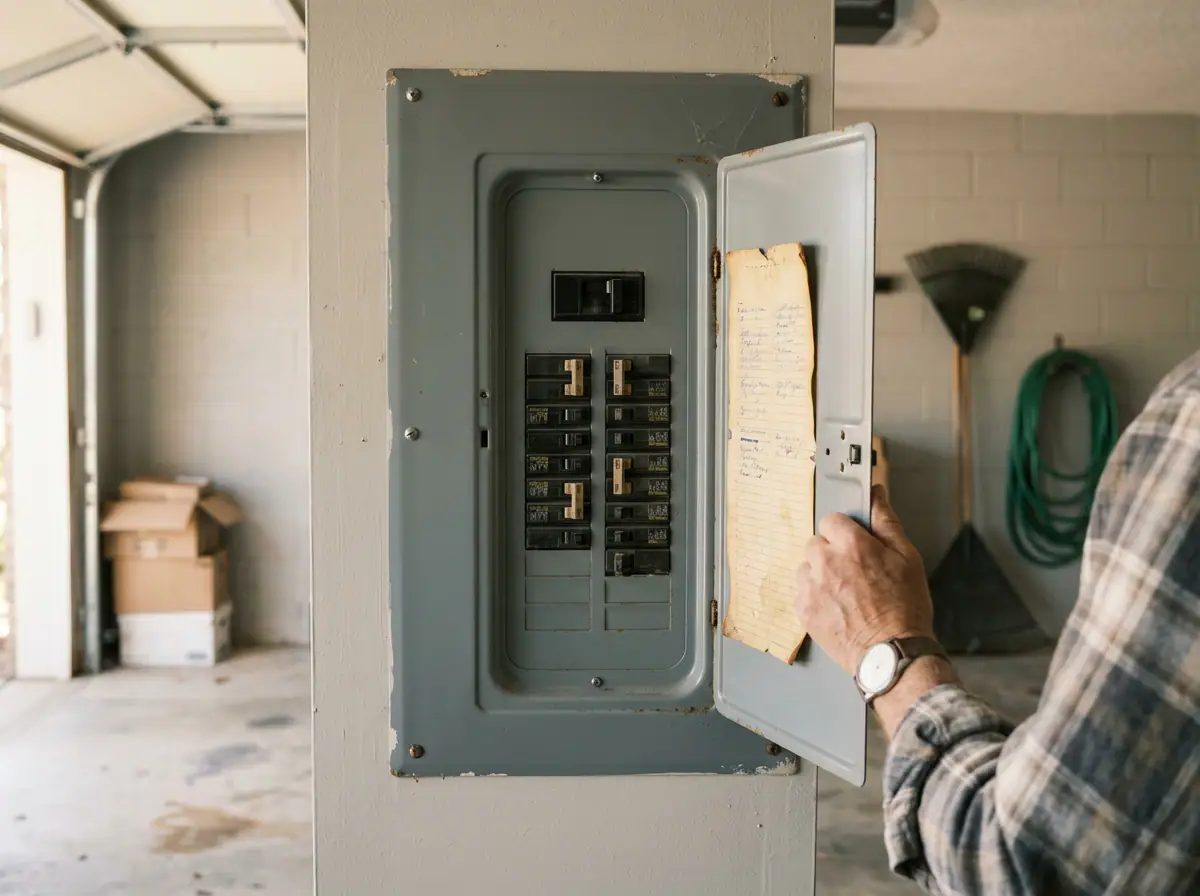
Find your main panel. In Granbury-area homes it is usually in the garage, a utility room, a hallway closet, or on an exterior wall. Open the hinged outer door. That is the only cover you should touch. Do not unscrew the inner metal cover.
Step 2: Look for the name
Check the inside of the door and the label area for any of these:
- "Federal Pacific Electric" or "FPE"
- "Stab-Lok" or "Stab-Lok Load Center"
- A circuit directory card printed with the FPE name
Step 3: Look at the breakers themselves
The breaker handles are visible without removing anything. FPE Stab-Lok breakers typically carry the FPE or Stab-Lok marking on the handle or face. Double-pole breakers, the wider ones that serve your range, dryer or water heater, often show it too.
Step 4: Take a photo
If you cannot find a brand name, or the label has worn off, take a clear photo of the open door and the breakers and send it to us. A label can fade over forty years, and we can usually tell the brand from a photo.
While you are there, note whether the box says Zinsco or Sylvania. Zinsco panels are another older brand that inspectors flag, for different reasons, so it helps to know what you have.
What Is the Concern With Stab-Lok Breakers?
A circuit breaker has one main job: when too much current flows through a wire, it trips and cuts the power before the wire overheats. The documented concern with Stab-Lok breakers is that some of them may not trip when they should, particularly under overload or short-circuit conditions.
Here is what is on the record, stated carefully. The U.S. Consumer Product Safety Commission (CPSC) investigated these breakers in the early 1980s. Since then, independent engineers and testing labs have run their own tests and reported that some Stab-Lok breakers failed to trip when they were supposed to. The CPSC has not issued a recall of these panels to our knowledge, and the question has stayed contested over the years. Because the debate is still alive, we encourage you to read the CPSC's own materials and independent test reports rather than rely on any one source, including us.
We are not going to quote a failure percentage, because we cannot source one to a standard we would stand behind. What we can say is practical: a breaker that might not trip defeats the purpose of having one. That is why home inspectors commonly flag FPE panels, and why many electricians recommend replacing them rather than living with the uncertainty. For broader context on how overloaded wiring becomes a fire risk, our guide on preventing electrical fires in your Granbury home is a good companion read.
Are Federal Pacific Panels Dangerous Right Now?
This is the question most people really want answered. A short version: an FPE panel is a known risk factor, not a guaranteed emergency. Many have run for decades without incident. But the risk is that the safety device may not work in the one moment you need it. So the question is less "will it fail today" and more "do I want to depend on it."
Call right away if you notice any of these
- The panel cover feels warm or hot to the touch
- A burning or hot plastic smell near the panel
- Scorch marks, discoloration or melted plastic on the panel or breakers
- A breaker that will not reset, or will not stay on
- Buzzing, crackling or sizzling from the box
If any of those are happening, back away from the panel, do not open or touch it, and call us at 817-677-0036. If you see smoke, flames or smell something actively burning, call 911 first. Our guide on what to do before the electrician arrives walks through those first steps.
Schedule an inspection if you notice these
- Breakers that trip repeatedly, especially on the same circuit (see our page on tripping breakers)
- Flickering or dimming lights when appliances start
- Your home is older and you simply have not had the panel looked at
- You are buying or selling the property
What Homeowners Should Not Do With an FPE Panel
- Do not remove the inner panel cover. The parts behind it stay energized even with the main breaker off. This is an electrician-only job.
- Do not swap in salvaged or mismatched breakers. Used Stab-Lok breakers from a resale site, or a different brand forced into the slot, can create a poor connection or an unlisted combination. That can be worse than what you started with.
- Do not ignore repeated trips. A breaker that keeps tripping is telling you something. Resetting it again and again, or taping a handle on, is not a fix.
- Do not paint over or hide the label. You and your inspector will both need it.
Federal Pacific Panel Replacement vs. Repair
Can an FPE panel be repaired? Technically you can replace an individual breaker, but replacement parts are hard to source reliably, and swapping a breaker does not answer the broader concern about the panel design. That is why most electricians, ourselves included, recommend replacing the whole panel instead of patching it.
The exception is the inspection step. Before quoting a replacement, we like to look at the full picture: the panel, the wiring that feeds it, the meter base, and the grounding. Sometimes that visit turns up a bigger story, such as damaged conductors or an overloaded service, and it is far better to learn that before the old panel comes out. If you want to know what that looks like, see our overview of a home electrical inspection in Granbury.
What Federal Pacific Panel Replacement Involves
Replacing a panel is a defined process, and knowing the steps takes the mystery out of it.
- Assessment and estimate. We look at the panel, service size and condition, and walk you through the scope.
- Electrical permit. A panel replacement is permitted work. The permit is pulled with your local jurisdiction, and the work is done to the National Electrical Code (NEC) edition adopted there.
- Utility coordination. The power to the panel has to be disconnected and restored with your electric utility. We coordinate that timing with you so you know when the power will be off.
- The swap. The old panel comes out, the new one goes in, and every circuit is reconnected, labeled and tested. Time on site varies with the job, and many replacements are a single-day project, though more complex ones take longer.
- Inspection. The inspector verifies the work, and then power is restored and finalized.
What drives the cost
We do not quote a one-size-fits-all number, because homes are not one-size-fits-all. These factors move the price:
- Amperage: whether you are keeping your current service size or increasing it for modern loads
- Meter base condition: a corroded or damaged meter base may need replacement
- Grounding: older homes often need grounding and bonding brought up to current standards
- Code updates: today's code may call for AFCI and GFCI protection on circuits that did not have it
- What is found behind the panel: damaged insulation, double-tapped conductors or past amateur repairs
We give free, upfront estimates so there are no surprises. For more on the service itself, see our panel changes page and our guide to signs your breaker box is overdue for a change.
Check These Older-Home Issues at the Same Time
An FPE panel usually means a home from an era when other things were done differently. Since the panel is already open for work, it is the right time to check:
- Aluminum branch wiring. Common in some homes from the 1960s and 1970s. Read our guide on aluminum wiring in older homes.
- Missing or ungrounded circuits. Two-prong outlets and missing grounds are common in older construction.
- Missing GFCI and AFCI protection. Kitchens, baths, garages, bedrooms and outdoor areas benefit from it. See GFCI and AFCI protection explained.
- Aging wiring in general. Our article on older home electrical wiring covers what to look for.
Buying or Selling a Home With an FPE Panel
If you are buying, expect the inspector to flag a Federal Pacific panel. It is a common line item in inspection reports, and it often becomes a negotiation point. If you are selling, the most helpful thing you can do is get ahead of it. A pre-listing electrical inspection tells you exactly what a buyer's inspector will find, so you can replace the panel on your timeline, or at least have a documented quote ready, rather than scrambling during the option period. Either way, it removes a surprise from the deal.
Federal Pacific Panel FAQ
Are Federal Pacific panels illegal?
To our knowledge, there is no federal ban that makes owning an existing FPE panel illegal, and the CPSC has not issued a recall. That said, they are no longer something you can install new, and local rules and inspection requirements vary. A replacement is permitted work done to current code.
Will insurance cover a home with an FPE panel?
It depends on the insurer and the policy. Some insurers ask questions about older panels, and some may require replacement or an inspection. The most reliable move is to ask your insurance company directly and get the answer in writing.
Can I just replace the breakers?
That is not the approach we recommend. Replacement Stab-Lok breakers are hard to source reliably, mixing parts can create new problems, and swapping a breaker does not address the broader concern about the panel. Replacing the panel is the cleaner fix.
How do I know who made my panel?
Open the outer door and check the label, the circuit directory and the breaker handles for the manufacturer's name. If it is unreadable, send us a photo and we will identify it.
Not Sure What You Have? Start With a Photo
You do not have to figure this out alone. We are a veteran-owned local company: Austin Barrett served in the U.S. Navy aboard the USS Jason Dunham, and Nick Torres grew up right here in Granbury. You can read more about our team. We serve Granbury, Tolar, Cresson, Weatherford, Stephenville and the rest of Hood County and the surrounding area.
Think you have a Federal Pacific panel? Snap a photo of the panel label and call Revamped Electric at 817-677-0036, or book a panel inspection through our contact page. If the panel is warm, smells like burning, or a breaker will not reset, call now.