

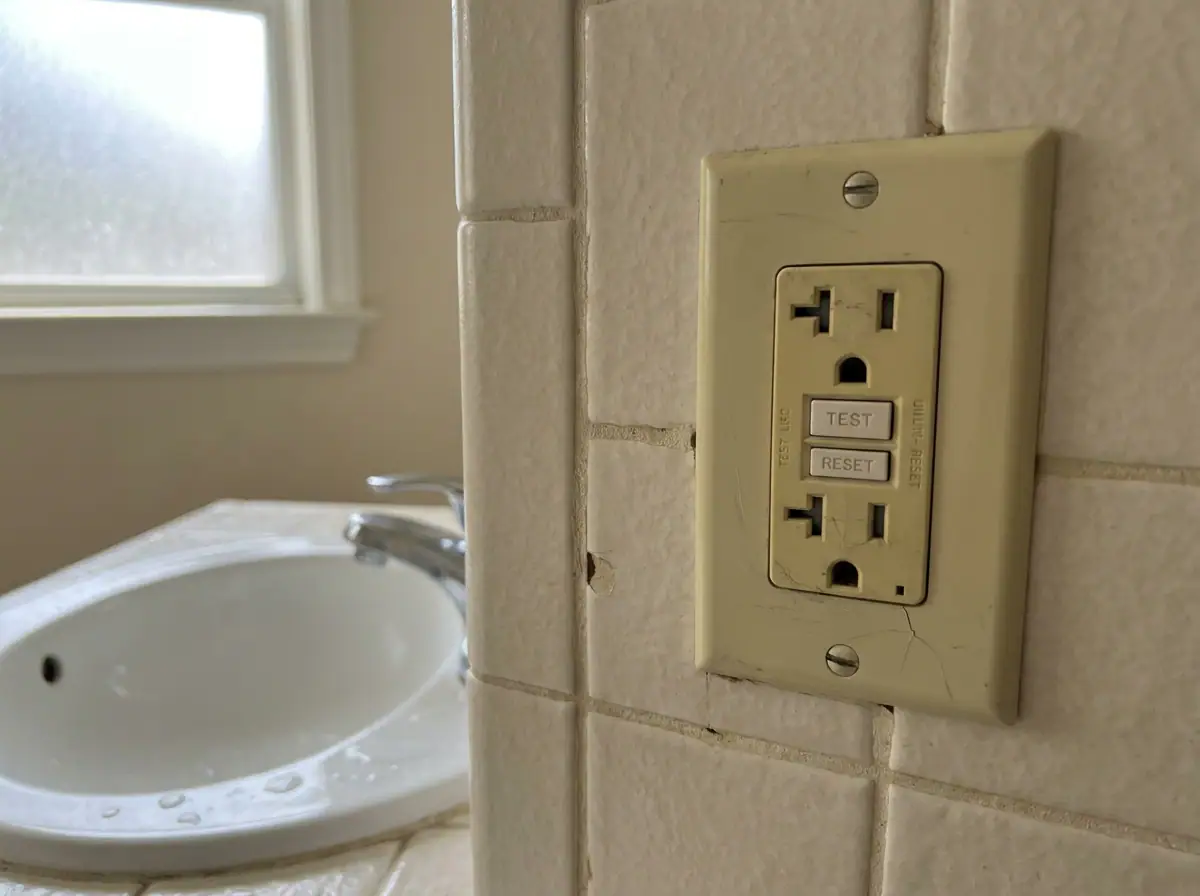
GFCI (Ground Fault Circuit Interrupter) protection stops electric shock by cutting power when current leaks to ground, and it is required where water is nearby: bathrooms, kitchen counters, garages, outdoors, crawl spaces, laundry areas and pools. AFCI (Arc Fault Circuit Interrupter) protection prevents electrical fires by cutting power when it detects dangerous arcing in wiring, and it is required on nearly all 15 and 20-amp circuits serving living areas such as bedrooms, living rooms, hallways and kitchens. Your home needs both, because they guard against completely different hazards.
Many Granbury and Hood County homeowners go years without knowing what these devices do, where they are required, or whether their home even has them. This guide explains how each one works, where code requires it room by room, how to test them, and how to upgrade.
What is a GFCI and how does it work?
A GFCI is the outlet with the small TEST and RESET buttons between the two receptacles, typically found in bathrooms, kitchens, garages and outdoors. GFCI protection can also be provided by a breaker in the panel.
A GFCI constantly compares the current flowing out on the hot wire with the current returning on the neutral. Normally they match. If it detects an imbalance as small as 4 to 6 milliamps, meaning electricity is finding an unintended path (often through a person), it cuts power in as little as 1/40th of a second. That is fast enough to prevent a fatal electrocution in most scenarios. It is what protects you if a plugged-in hair dryer falls into a sink, or if a faulty appliance starts leaking current through its metal housing.
Where GFCI protection is required
The National Electrical Code (NEC), which Texas adopts and enforces through local jurisdictions, requires GFCI protection wherever electricity and water have a realistic chance of meeting:
- Bathrooms: all receptacles, with no exceptions
- Kitchens: countertop receptacles, including those within 6 feet of a sink
- Garages and outbuildings: all receptacles in attached and detached garages, with limited exceptions
- Outdoors: every exterior outlet, which must also be weatherproof
- Crawl spaces and unfinished basements: all receptacles
- Laundry areas: outlets within 6 feet of sinks and washing machine receptacles
- Wet bars and utility sinks: outlets within 6 feet of the water source
- Boathouses and pool/spa areas: all receptacles near water
Code requirements have changed a great deal over the years. If your home was built or last renovated before the mid-1990s, several of these areas probably lack GFCI protection, which makes older Granbury homes common candidates for an outlet upgrade.
What is an AFCI and why does it matter?
An arc fault happens when electricity jumps, or arcs, across a gap in damaged, deteriorated, loose or improperly installed wiring. The arc generates intense heat that can ignite insulation, wood framing, wall material or furniture. Common causes include:
- A nail driven through a wire while hanging pictures
- Rodents chewing through cable insulation
- Old wiring with cracked insulation
- Loose connections in outlets or junction boxes
- Damaged cords on lamps and appliances, including cords crushed under rugs
Arc faults are silent and often hidden inside walls, so by the time you smell smoke the situation may already be serious. Standard breakers cannot detect them, because a small, persistent arc does not draw enough current to trip a normal breaker. An AFCI analyzes the electrical waveform, tells harmless arcing (like unplugging an appliance) apart from the signature of a dangerous fault, and trips the circuit immediately.
According to the U.S. Fire Administration, electrical fires account for tens of thousands of home fires every year, and the Consumer Product Safety Commission has said AFCIs could prevent thousands of home fires each year. Because aging or faulty wiring is one of the top contributors to arc faults, fixing wiring and adding AFCI protection often go hand in hand.
Where AFCI protection is required
The NEC has expanded AFCI requirements significantly in recent code cycles. AFCI protection is now required for nearly all 120-volt, 15 and 20-amp branch circuits serving living areas, including:
- Bedrooms (required the longest)
- Living rooms, family rooms, dens and parlors
- Dining rooms
- Hallways and closets
- Kitchens and laundry areas
- Libraries, studies, sunrooms and recreation rooms
- Finished basements and attics
In short, if it is a living space where you spend time, it likely requires AFCI protection. Bathrooms, garages, unfinished basements and outdoor locations are typically exempt, because they need GFCI protection instead or have different circuit configurations. For new construction and major renovations, meeting AFCI requirements is non-negotiable for passing inspection. For existing homes it is highly recommended, especially with older wiring.
GFCI vs. AFCI: the key differences
- Hazard: a GFCI protects people from shock caused by ground faults. An AFCI protects the home from fire caused by arc faults.
- What it detects: a GFCI measures the difference between current on the hot and neutral wires. An AFCI analyzes the current's waveform for the signature of hazardous arcing.
- Where it is used: GFCIs are required in wet or damp locations. AFCIs are required in dry living spaces.
- Typical form: GFCI protection is most often an outlet in a wet area. AFCI protection is most often a breaker in the panel. Both can be installed either as receptacles or as breakers that protect the whole circuit.
- Response: both react very quickly. GFCIs trip in as little as 1/40th of a second. AFCIs use slightly different timing to avoid nuisance trips from normal household activity.
They do not compete with each other. For complete protection you need both.
Combination AFCI/GFCI devices
Dual-function AFCI/GFCI breakers and outlets monitor a circuit for arc faults and ground faults at the same time, from a single device or breaker slot. They are increasingly common in new construction and during panel changes, and they are especially useful where requirements overlap:
- A kitchen circuit, where AFCI protection covers the room and GFCI protection is required at countertop receptacles near the sink.
- Laundry rooms, which require both types of protection under current code.
- A finished basement with a wet bar, which needs GFCI for the sink and AFCI because it is a living space.
Combination devices consolidate protection and reduce the number of separate components to manage and test. An electrician can decide where breakers, outlets or a combination make the most sense, without redundant devices.
Room-by-room guide
Start with the highest-risk areas and work outward.
Kitchen
- GFCI: required at countertops and near sinks, protecting you when using blenders, dishwashers and disposals.
- AFCI: required on kitchen circuits under current code. Kitchens have lots of cords, thermal cycling and potential loose connections, ideal conditions for arc faults.
- If you have two-prong or unprotected outlets, upgrade them or add a combination AFCI/GFCI breaker for kitchen circuits.
Bathrooms and exterior areas
- GFCI: required in bathrooms, at outdoor outlets, in pool/spa areas and in garages.
- AFCI: not always mandated for exterior circuits, but it adds fire prevention, especially for circuits that also run through living spaces.
Bedrooms and living spaces
- AFCI: required, because many electrical fires start on these circuits from lamps, chargers and cord damage.
- GFCI: not typically required in bedrooms, but recommended where there is moisture exposure, such as an en suite.
Garage, workshop and utility spaces
- GFCI: required for garage and outdoor outlets to protect against shock from tools and damp conditions.
- AFCI: highly recommended for workshop circuits, where power tools and extension cords can cause arcs. Install dedicated workshop circuits with AFCI protection and separate GFCI protection near sinks or exterior doors.
HVAC, appliances and large loads
- Dedicated circuits for HVAC, electric ranges, dryers and EV chargers should be checked for overload protection and any device-specific GFCI/AFCI requirements.
- EV chargers and outdoor HVAC equipment sometimes need specific GFCI protection or a GFCI-type breaker. Check manufacturer requirements and local code, and raise it when planning any new circuit.
Signs your home is missing protection
- No TEST/RESET buttons on bathroom or kitchen outlets: you almost certainly have standard outlets where GFCIs belong.
- Two-prong outlets: usually a sign of an aging system without a ground wire, and very likely without GFCI protection.
- An old fuse box or outdated panel: breakers that predate AFCI technology cannot detect arc faults. Panels older than 20 to 30 years may not safely accept modern AFCI/GFCI breakers.
- Flickering lights or frequent, unexplained breaker trips: these can signal arc faults or wiring problems developing inside walls.
- Loose, warm, discolored or damaged outlets: possible wiring problems where AFCI protection could prevent a fire. Do not wait for a burning smell or sparks.
- Shocks or tingles when touching appliances or plumbing fixtures: current leakage that GFCI protection would stop. Address it immediately.
- An older home: each code cycle added requirements. Homes built before about 2000, and especially before the mid-2000s for AFCI, are almost always missing some modern protection.
- A planned remodel or sale: permitted work requires affected circuits to meet current code, and many home inspectors flag missing GFCI and AFCI protection.
None of these means disaster is imminent, but each is a good reason to schedule a professional evaluation.
Common problems with GFCI and AFCI devices
Nuisance tripping
AFCI breakers in particular sometimes trip with no obvious cause. Reasons include:
- Older appliances or tools that produce harmless arcs resembling arc faults
- Wiring that was not properly installed or terminated
- Long circuit runs with high capacitance
- Compatibility issues between some breaker brands and wiring configurations
GFCIs can be sensitive to leakage from extension cords or pooled moisture. Never work around persistent tripping by swapping an AFCI for a standard breaker. An electrician can find out whether the device is faulty, the circuit has a real problem, or the installation needs correcting, and may move sensitive loads to dedicated circuits or use properly matched combination breakers.
A GFCI that will not reset
If the RESET button pops right back out or will not stay engaged, there may still be an active ground fault, the device may have failed, the outlet may be miswired, or there may be moisture in the outlet or box. Stop using it: a GFCI that cannot reset cannot protect you. Our outlet repair team can find the cause.
Outlets that stop working for no obvious reason
One GFCI outlet can protect several downstream outlets on the same circuit, sometimes in a different room. If bathroom, garage or other outlets go dead, first look for a tripped GFCI elsewhere on the circuit. If resetting does not help, or you cannot find the responsible GFCI, call an electrician.
How to test your devices
- GFCI outlets: press the TEST button. The outlet should lose power and the RESET button should pop out. Plug in a small lamp to confirm the power is off, then press RESET. Test monthly, or at least a few times a year.
- AFCI breakers: with the breaker ON, press its test button. It should trip. Flip it fully OFF, then back ON. If it does not trip, the breaker may have failed and should be replaced.
If you are not comfortable working at the panel, or a device does not behave as expected, call a licensed electrician.
How to upgrade: a step-by-step plan
- Do a quick safety audit: look for two-prong outlets, unprotected bathroom and kitchen receptacles, warm or discolored outlets, frequent breaker trips and flickering lights, and note the age of your panel.
- Prioritize high-risk areas: kitchens, bathrooms, garages and exterior outlets first, then bedrooms and living areas with AFCI protection where code requires it.
- Choose the right device: receptacle GFCIs for localized protection (bathrooms, counters). AFCI protection is typically a breaker in the main panel, and combination breakers cover both.
- Plan with a licensed electrician: they check the panel, recommend combination devices where appropriate, and handle permits and inspections. If the panel is full or too old, a panel change or subpanel may be needed to add AFCI/GFCI breakers.
- Test and document: test every GFCI and AFCI after installation, and keep records and receipts for insurance and resale.
Good times to upgrade are during a panel replacement, a remodel, a basement finish, or whenever new circuits are added.
DIY or licensed electrician?
Swapping a receptacle for a GFCI outlet is sometimes described as a simple DIY task if you are comfortable with basic wiring and turn off the breaker first. But a GFCI wired incorrectly can seem to work normally yet fail to trip during a real fault, and an amateur install can miss existing wiring problems. Installing AFCI breakers, changing a main panel, or modifying multi-wire branch circuits means working inside the panel, where mistakes carry serious consequences, and should be done by a licensed electrician. In Hood County and surrounding areas, electrical work is subject to local inspection, and unpermitted work can complicate a home sale or insurance claim, or create liability if an accident occurs.
What does an upgrade cost?
Cost depends on the number of outlets and circuits, home size, the age and condition of your wiring, and whether panel work is needed. Simple receptacle swaps cost less, while adding AFCI breakers or changing a panel is more involved. For most homeowners the investment is modest compared with the protection it provides, making it one of the highest-value safety upgrades you can make. Revamped Electric gives transparent, upfront pricing before any work starts and can help you prioritize upgrades to fit your budget.
Frequently Asked Questions
What is the difference between GFCI and AFCI?
A GFCI prevents electric shock by detecting current leaking to ground. An AFCI prevents electrical fires by detecting dangerous arcing in wiring and cords.
Can one device do both jobs?
Yes. Combination AFCI/GFCI breakers and outlets provide both protections on one circuit and are useful in kitchens, laundry rooms and wet bars, where both are required.
Are GFCIs required in bedrooms?
Not typically. Bedrooms need AFCI protection. GFCI is recommended where a bedroom area is exposed to moisture, such as an en suite.
Why does my AFCI or GFCI keep tripping?
It may be a real fault, an older appliance, poor installation, long circuit runs, moisture, or a compatibility issue. Have it diagnosed instead of replacing the device with a standard one.
How often should I test GFCI outlets?
Monthly, or at least a few times a year, using the TEST and RESET buttons.
Does my older home need to be upgraded?
Even if your home was built before these requirements existed, upgrading is highly recommended, and any remodel that needs permits and inspection will bring the affected circuits up to current code.
Revamped Electric is a veteran-owned company, founded by a US Navy veteran, serving Granbury, Weatherford, Stephenville, Aledo, Mineral Wells, Benbrook and the rest of Hood, Parker, Johnson and Somervell counties. We will check your outlets, breakers and circuits and explain exactly what your home needs. Call 817-677-0036 or request a quote, or see all our electrical services.