

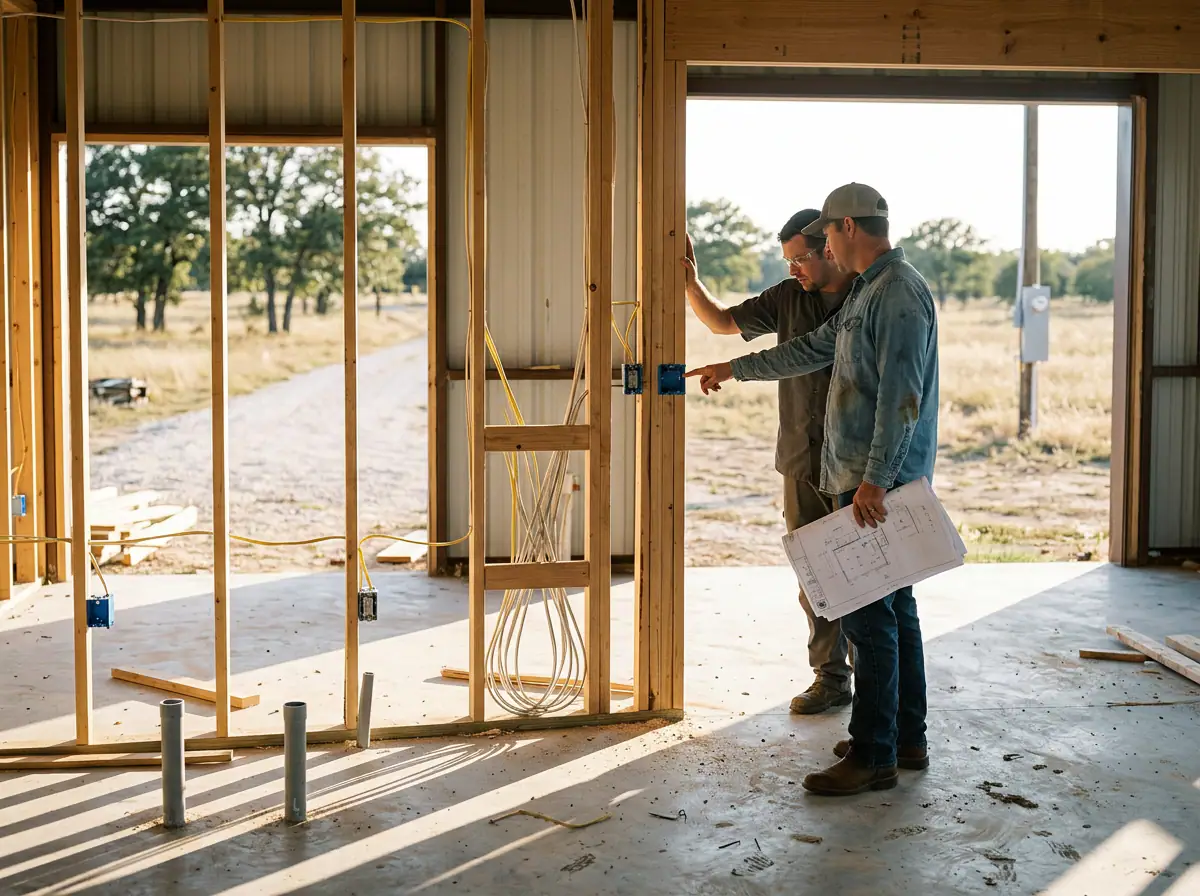
If you are putting up a custom home, a barndominium or a shop on a piece of ground around Weatherford, the electrical work will touch almost every stage of the build. Getting it right early saves headaches later. This guide covers new build electrical services in Weatherford, TX from the owner-builder's point of view: what happens in what order, who you need to talk to, and where a lot inside the city differs from rural acreage in Parker County.
We are Revamped Electric, a veteran-owned electrical contractor based in Granbury, and Weatherford is part of the area we serve. Austin Barrett, a U.S. Navy veteran, owns the company, and Nick Torres, a Granbury native, handles much of our new construction work. Revamped Electric holds Texas Electrical Contractor License 40771. Here is how we walk a Weatherford or Parker County build from the first sketch to the final.
Who This Guide Is For
Most of the people who call about a new build fall into one of three groups, and the electrical conversation is a little different for each.
- Owner-builders who are acting as their own general contractor and need someone to help sequence the electrical, the utility and the inspections.
- Custom home buyers working with a builder who want to understand the electrical plan, ask smart questions and make sure upgrades are not forgotten.
- Barndominium and shop builders on acreage around Weatherford, Aledo and Cresson, where long service runs, metal buildings and outbuildings change the plan.
If you are in one of these groups, you are in the right place. If you want the broader overview of what we do on builds, our new construction page covers the service in general terms.
The New Build Electrical Process in Weatherford, Step by Step
Every build is different, but the electrical side follows a predictable path. Knowing the order helps you schedule the right people at the right time.
1. Plan review and load calculation
Before anyone pulls wire, we look at your plans. That means the floor plan, the square footage, the HVAC equipment, the kitchen appliances, the water heater, any pool, shop or outbuilding, and anything you know you will add later. From that we do a load calculation under the National Electrical Code (NEC) to size the service and the panel. This is the step where most of the money-saving decisions happen, because changing a panel size on paper is easy and changing it after the walls are closed is not.
2. Temporary power pole
Your framers, plumbers and HVAC crews need power on site. A temporary power pole gives them a safe, inspected place to plug in. For a temporary power pole in Weatherford, TX, the details depend on where the lot sits and who serves it. We will cover that below, but the practical advice is to start this request early, because the utility often controls the schedule.
3. Rough-in
Once the house is framed and the roof is on, we run the cable, set the boxes and pull wire to the panel location. This is the rough-in. It is the best time to walk the house with us, because it is when you can still say "put an outlet on that island end" or "add a circuit for the garage freezer" without opening drywall. Lighting layouts, ceiling fan boxes, data and low-voltage pathways, and outdoor receptacles all get settled here.
4. Rough-in inspection
Before insulation and drywall, the work gets inspected. Who inspects depends on your location, which is the subject of the next section. We build to the NEC and the local requirements, and we walk the job ahead of the inspector so problems are caught on our end first.
5. Trim-out
After drywall and paint, we come back for the trim-out: devices, switches, receptacles, GFCI and AFCI protection where required, light fixtures, fans, and the panel's final terminations. Trim-out goes faster when the fixtures are on site and the homeowner has made their selections.
6. Final inspection and meter set
The final inspection confirms the finished work. After that, the utility sets or releases the meter and the home is energized permanently. The meter base has to meet the utility's requirements, which is one more reason to talk to them before the service equipment goes on the wall.
City of Weatherford Limits vs. Unincorporated Parker County
This is where Weatherford builds differ most from builds in other towns. A lot inside the City of Weatherford and a lot out on county acreage can have different processes for permits and inspections. We are not going to quote fees or timelines here, because they change and they come from the agency, not from us. What we can do is tell you what to ask and who to check with.
If your lot is inside City of Weatherford limits
- Ask the city's building or permitting office how electrical permits are submitted and what plans they want to see.
- Ask which edition of the NEC the city has adopted and whether any local amendments apply.
- Ask how inspections are requested and which stages require one, such as the temporary service, rough-in and final.
- Confirm who is allowed to pull the permit. We work as a Texas licensed electrical contractor, and a TDLR licensed electrician is the standard expectation for this work.
If your lot is in unincorporated Parker County
- Do not assume the rules match the city's. Contact the county and ask what, if anything, is required for residential electrical work on your parcel.
- Ask the utility what it requires before it will connect service, since some utilities want proof of inspection before energizing a new service.
- Ask your lender or insurer if they have their own inspection expectations. Many do on new construction.
- Ask about addressing and access, because a clear address and a workable drive make utility scheduling easier.
Our advice is to make these calls before you break ground, not after. Whatever the local answer is, we wire to the NEC and treat every job as if it will be inspected.
Which Utility Serves Your Lot, and Why It Matters
Around Weatherford and the rest of Parker County, the company that serves your address is not always the same as your neighbor's. A property in town and a property a few miles out can be on different systems. Before you finalize the electrical plan, find out which utility serves the lot. We do not assume, and you should not either. Your county records, your builder or a quick call to the utilities in the area will tell you.
It matters because the utility drives several decisions:
- Service size. What the utility will deliver to your site, and under what conditions, affects the panel and service entrance we design.
- Meter base requirements. Each utility has specifications for the meter base and how it is mounted. Buying the wrong one can cost you a delay.
- Scheduling. The utility's timing for the temporary service and the permanent meter set often decides when your build can move forward.
- Who runs what. On longer runs, the line between the utility's work and the electrician's work needs to be clear from the start.
Rural Acreage, Barndominiums and Shops Around Weatherford
Properties near Aledo, Cresson and the open parts of Parker County bring their own questions. Acreage is great, but it makes the electrical plan more involved.
- Long service runs. When the house sits far from the road, the distance from the meter to the buildings affects conductor sizing and cost.
- Detached shops and outbuildings. A shop usually needs its own subpanel, proper grounding and feeders sized for welders, compressors and lighting. We cover this in more depth in our guide to barndominium and shop wiring.
- Well pumps. A well pump needs a properly sized dedicated circuit and often has a long run to the well head.
- Gate openers and barns. Entry gates, barn lighting and stock-water heaters all need planned power and weather-rated equipment.
- Barndominium specifics. Metal buildings handle conduit, boxes, bonding and insulation differently from a typical stick-built home. A barndominium electrician in Weatherford should plan the wiring path before the slab is poured and the steel goes up.
If you are working with a builder, bring us in while the slab plumbing and conduit stubs are still being laid out. That is the cheapest time to put a pipe in the right place.
Plan for the Future While the Walls Are Open
The best time to add capacity is during the build. A few items are worth discussing with your electrician early:
- Panel size. Think about the home you want in ten years, not just today. If you want to learn how panel decisions work later on, our page on panel changes explains what is involved.
- EV charger circuit. Running a conduit or circuit to the garage now is far easier than later. See our guide on preparing your home for an EV charger.
- Standby generator readiness. Even if you are not buying a generator today, leaving space and a plan for a transfer switch is cheap insurance. Read more in our article on generator installation and transfer switches.
- Whole-house surge protection. North Texas storms are hard on electronics, and a surge protector at the panel is easiest to add at the start. See whole house surge protector installation.
- Dedicated circuits. Kitchen appliances, HVAC equipment, water heaters and similar loads should have their own circuits. Here is why high-demand appliances need their own circuit, and our circuit installation page covers the service.
What Drives the Cost of New Build Electrical Work
We are not going to throw out a price per square foot, because every build is different and a number without context does more harm than good. What we can tell you is what moves the price up or down:
- Square footage and layout. More rooms and more wire mean more labor and material.
- Panel and service size. A larger service and panel cost more up front but give you room to grow.
- Lighting plan. Recessed lighting, specialty fixtures and outdoor lighting add device counts and labor.
- Outbuildings. A detached shop, barn or guest house needs feeders, a subpanel and its own protection.
- Service run length. The farther the buildings are from the meter, the more conductor, trenching and conduit are involved.
- Change orders. Changes after rough-in cost more than decisions made on paper.
We give upfront, itemized quotes so you can see where the money goes.
Working With Your Builder
On a new build, good coordination does as much for the schedule as good wiring. When we work alongside your builder or you as the owner-builder, we aim to:
- Confirm the electrical scope and the plan before the build starts.
- Line up the temporary power, rough-in, trim-out and final with the framing, drywall and finish schedule.
- Do a walkthrough at rough-in so you can see outlet, switch and fixture locations while changes are easy.
- Put any change orders in writing, with the cost and schedule impact described before the work happens.
- Communicate clearly with inspectors and the utility so nothing stalls at the end.
We are a small team, so you talk to the people doing the work. Learn more about Austin and Nick. If you are comparing us with other contractors, our Granbury new construction article shows how we handle builds in Hood County.
Frequently Asked Questions About New Build Electrical in Weatherford
How early should I bring in an electrician?
As early as the plan stage, and before framing starts. That lets us size the panel, plan the circuits and coordinate the temporary power with your builder.
Do I need a temporary power pole?
Most new builds do. Crews need safe power on site during construction. Ask the utility and the permitting office what they require for your address.
Can you wire a barndominium?
Yes. We work on barndominiums and metal-building shops, including subpanels, feeders and living-space wiring. Planning conduit and boxes before the slab and steel go in makes the job smoother.
Who inspects the work?
It depends on whether your lot is inside the City of Weatherford or in unincorporated Parker County. Check with the city or county and your utility, and we will build to the NEC either way.
What areas around Weatherford do you serve?
We serve Weatherford, Aledo, Cresson and the surrounding Parker County area, along with Granbury and Hood County, where we are based.
Ready to Plan Your Weatherford or Parker County Build?
A new build is one of the few times you get to decide how your electrical system will work for the next several decades. A short conversation before framing can prevent expensive changes later. Call Revamped Electric at 817-677-0036 or use our contact page to book a plan review for your build. We will go through the panel size, circuits and future upgrades with you so they are planned once and done right.