

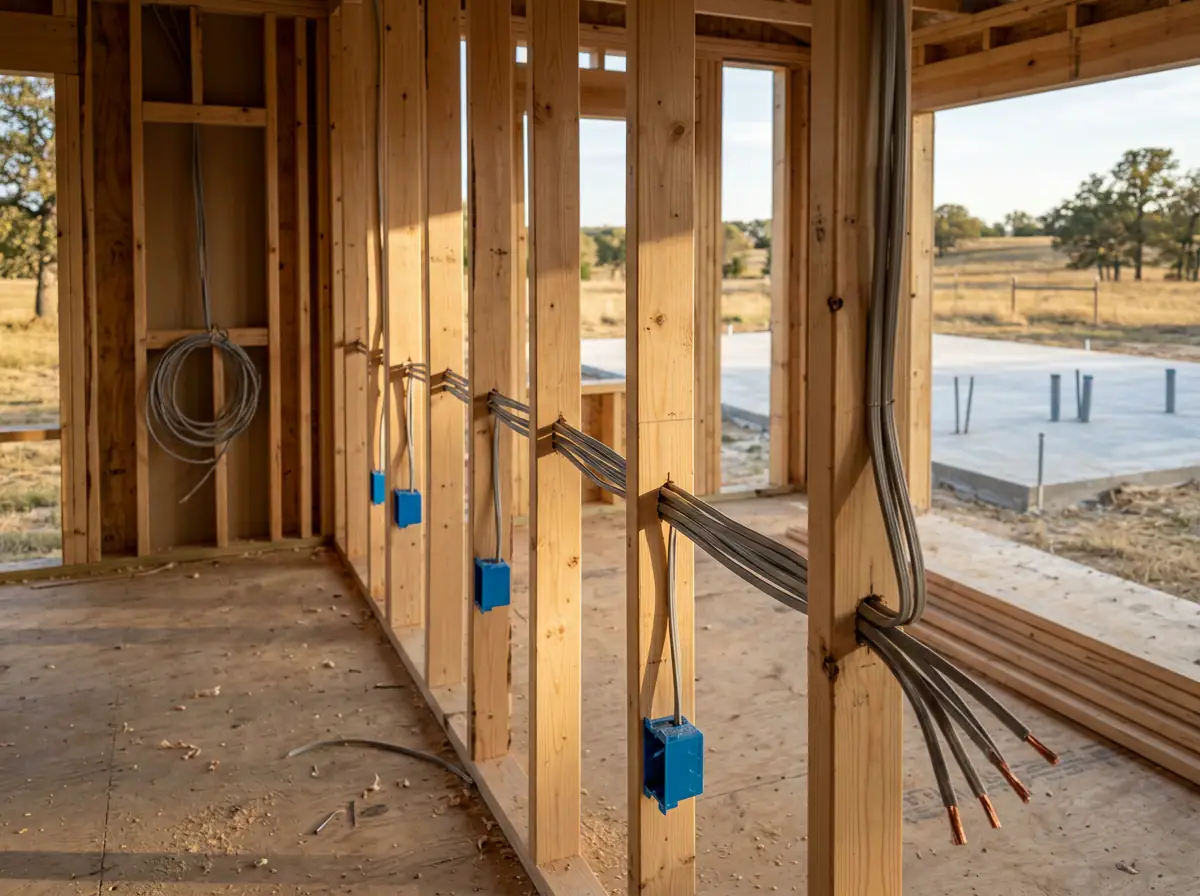
If you are lining up new build electrical services in Stephenville, TX, you are probably juggling a long list: land, plans, a builder, a well, a septic system, and a hundred other decisions. Electrical is one of the few trades where choices made early are very hard to change later. Once the walls are closed and the slab is poured, moving an outlet or adding a circuit gets expensive and frustrating.
This guide walks through the electrical side of a new home from the first temporary pole to the final inspection. It is written from the point of view of a veteran-owned electrical contractor that serves Stephenville and the rest of Erath County, so you know what to expect and what to decide before the crew shows up.
Who This Guide Is For
This page is for custom home builders, owner-builders, and families building in Stephenville or on rural Erath County land. It also applies if you are putting up a barndominium, a detached shop, or a guest house. If you have already hired a general contractor, you can hand this to them and use it to ask better questions. If you are acting as your own general contractor, it will help you sequence the electrical work so nothing gets missed.
Every build is different, so none of what follows is a promise of a price or a schedule. It is a framework for planning.
New Build Electrical Services in Stephenville: The Stages, Start to Finish
New home wiring in Stephenville follows the same basic path as anywhere else in Texas. Knowing the order helps you schedule other trades around it.
1. Temporary Power
Before framing gets far, your crews need electricity for saws, compressors, and lighting. That usually means a temporary power pole: a pole with a meter base, a few receptacles, and proper protection, set on the lot. Your electric provider has its own process for connecting it, and on rural land that process can take some coordination, so ask about it early. Do not wait until you are ready to frame.
2. Service Entrance and Meter Base
The service entrance is where power from the utility reaches your home. It includes the meter base, the service conductors, the grounding electrode system, and the main disconnect or main panel. The size of this service is one of the biggest decisions in the whole project, and we cover it below. Where the meter and panel sit also matters. Think about wall space, clearances, and how close they are to the driveway and future outbuildings.
3. Rough-In
Rough-in is when the wiring goes in before insulation and drywall. Cable is pulled through the framing, boxes are set, circuits are run back to the panel location, and low-voltage runs are placed. This is the stage where the electrician needs your layout finalized. If you are building on a slab, some conduit and underground work happens even earlier, before concrete.
4. Inspection
After rough-in, the work is typically inspected before the walls are covered. Who inspects depends on where the lot sits, and we cover that further down. Inspectors look at things like box fill, cable support, protection where wires pass through framing, and whether the required protection devices are planned.
5. Trim-Out
Trim-out comes after drywall and paint. Receptacles, switches, cover plates, light fixtures, ceiling fans, and the panel's breakers and labeling all go in. This is when your home starts to look like a finished house.
6. Final and Power On
Once the finish work is done, the system is checked and the final inspection is completed. The utility then handles its own steps to energize the permanent service. We test circuits and protective devices before we hand the house over, so you are not discovering a dead outlet on move-in day.
Our new construction page gives an overview of how we approach this process, and our Granbury new construction guide covers the same work for Hood County builds.
Decisions to Make Before Rough-In
The best time to talk to your electrician is before the walls go up. Here is what to settle before rough-in starts.
Outlet and Lighting Layout
Walk through the plans room by room and picture how you will actually live there. Where does the couch go? Which side of the bed needs outlets? Where will a TV mount? Do you want lighting over the island, under the cabinets, or in the closets? Do you want switches at both ends of a hallway? Code sets minimums, but a good layout goes beyond them. Adding an outlet during rough-in is a small job. Adding it after drywall is not.
Kitchen and Bathroom Circuits
Kitchens carry the heaviest and most demanding loads in the house. Plan for the countertop receptacles, the refrigerator, the dishwasher, the disposal, the microwave, and the range or cooktop. Bathrooms need GFCI protection and thoughtful lighting around the mirrors. We break down the details in our guide to kitchen electrical requirements, and the same principles apply to a home in Stephenville.
Dedicated Appliance Circuits
Large appliances such as an electric range, dryer, water heater, HVAC equipment, and a freezer in the garage should each be on their own circuit. Decide on gas versus electric early, because it changes what gets wired. If you are not sure what you will want in five years, run extra capacity now. You can read more about circuit installation and how dedicated circuits protect your home from overloads.
Low-Voltage and Data Runs
Decide where internet, cameras, doorbells, speakers, and smart-home hubs will live. Low-voltage cable is easiest to place at rough-in. A central spot for the network equipment, with data runs to key rooms, makes a big difference in how reliable your home Wi-Fi turns out to be, especially on larger rural footprints.
Sizing the Panel and Service for Future Loads
A new build is the one time you can size your electrical system correctly without tearing anything apart. A proper load calculation under the National Electrical Code (NEC) tells us how much capacity the home needs today. Then it is smart to ask what you might add later. Replacing an undersized panel after the fact is possible, and we do panel changes regularly, but it is easier and often more economical to plan ahead.
EV Charger Readiness
Even if you do not own an electric vehicle today, it is cheap insurance to plan for one. A 240-volt circuit stubbed to the garage, or empty conduit run to the right spot, makes a future charger simple to add. Our guide on preparing your home for an EV charger explains what to consider.
Shops, Barndominiums and Outbuildings
If you plan to add a shop, a barn, or a guest house, tell your electrician now. We can leave space in the panel, size the feeder, and run conduit before trenching or concrete work happens. For a barndominium, the living space and the shop area often have very different load profiles, and a subpanel can keep them organized. We cover this in more detail in our article on barndominium and metal building wiring, and the same planning applies to barndominium electrical in Stephenville.
Generator Inlet or Transfer Switch
Rural properties can lose power for longer stretches, and many families want backup power. A transfer switch or a generator inlet lets you run key circuits safely without backfeeding the utility lines. Planning for it during the build means the panel layout, the circuit selection, and the generator location are all worked out in advance. See our overview of backup power planning for the options.
Code Basics Every Builder Should Know
Electrical work in Texas is governed by the National Electrical Code (NEC), adopted and enforced locally. We will not try to list every rule here, but a few basics are worth knowing.
- AFCI and GFCI protection: The NEC requires ground-fault and arc-fault protection in many areas of a new home, such as kitchens, bathrooms, garages, outdoor locations, and living spaces. Our overview of GFCI and AFCI protection explains what each one does.
- Licensed electricians: Electrical work in Texas should be done by electricians licensed through the Texas Department of Licensing and Regulation (TDLR). Revamped Electric holds Texas Electrical Contractor License 40771.
- Permits and inspections: Requirements depend on whether your lot is inside Stephenville city limits or in unincorporated Erath County. We do not want to guess at local rules for you, so confirm with the city or the relevant agency, and with your electric provider, before you begin.
Rural and Acreage Builds Around Stephenville
Many Erath County builds sit well off the road, and that changes the electrical plan.
- Long service runs: The farther the home is from the utility connection, the more attention the conductors, trenching, and voltage drop need.
- Detached shops and barns: A separate building typically needs its own feeder and subpanel, with proper grounding.
- Well pumps: A water well needs a reliable, correctly sized circuit, and it is often a prime candidate for backup power.
- Outbuildings and yard loads: Pole barns, RV hookups, pens, gates, and outdoor lighting all add up. Mapping them early avoids rework.
If your property includes ponds, livestock areas, or equipment sheds, mention them at the first walkthrough.
What Drives the Cost of New Build Electrical Work
We do not quote prices in a blog post, because every plan is different. But here is what generally moves the number up or down:
- Square footage: More space means more circuits, more wire, and more labor.
- Service size: A larger panel and service entrance cost more than a basic one.
- Fixture and device count: Recessed lighting, specialty fixtures, ceiling fans, and extra outlets all add time and materials.
- Outbuildings: Shops, barns, and guest houses each need their own feeders and panels.
- Distance from the utility: Longer runs mean more conductor, more trenching, and more planning.
- Future-ready features: EV circuits, generator connections, and extra conduit add to the initial scope but save money later.
A clear plan and an upfront quote are the best defense against surprises.
Why Builders and Families Choose Revamped Electric
Revamped Electric is veteran-owned and run by Austin Barrett, a U.S. Navy veteran who served aboard the USS Jason Dunham. Co-owner Nick Torres, a Granbury native, focuses on new construction and service calls. We are a small team, which means the people who walk your plans are the people who do the work. Our values are simple: honor, integrity, and craftsmanship, and treating customers like family and neighbors. You can learn more on our about page.
We are based in Granbury in Hood County and serve Stephenville and Erath County, an easy drive along US-377. If you want a closer look at our local work, our Stephenville electrician page covers repairs, inspections, and more.
Frequently Asked Questions About New Build Electrical in Stephenville
When should the electrician be brought in on a new build?
As early as possible, ideally when the plans are final and before framing or slab work begins. Early involvement lets us plan temporary power, panel location, conduit under the slab, and circuit needs before they become expensive to change.
Can you wire a barndominium in Erath County?
Yes. We wire barndominiums, shops, and metal buildings, including living areas, shop spaces, subpanels, and the service to feed them. The details depend on the building, the loads, and local requirements.
Do I need a permit for new construction electrical work?
Permit and inspection requirements depend on whether your lot is inside Stephenville city limits or in unincorporated Erath County. Confirm with the appropriate agency and your electric provider before work begins.
Can I plan for an EV charger or a generator before I move in?
Absolutely, and a new build is the best time to do it. We can reserve panel space, run conduit, and set up a transfer switch or generator inlet so you can add equipment later without opening walls.
Do you serve Stephenville if you are based in Granbury?
Yes. We are headquartered in Granbury and regularly serve Stephenville and surrounding Erath County communities.
Plan the Wiring While the Walls Are Still Open
A well-planned electrical system is something you will never think about once you move in, and that is the goal. The outlets are where you need them, the breakers do not trip when the oven and the AC run together, and the panel has room for whatever comes next.
Building in Stephenville or Erath County? Call Revamped Electric at 817-677-0036 or use our contact page to book a plan review before rough-in, so the panel, circuits, and outlet layout are decided while the walls are still open.