

A ceiling fan looks like a simple job: take down the old fixture, hang the new fan, tighten a few screws. But a fan is a heavy, moving load on a ceiling box, wired to a switch that was probably chosen for a light bulb. If you are searching for ceiling fan installation Granbury TX, the difference between a fan that runs quietly for years and one that wobbles, hums or works loose comes down to what happens above the ceiling. That is the part Revamped Electric checks on every job.
We are a licensed, veteran-owned electrical contractor based in Granbury. Owner Austin Barrett, a U.S. Navy veteran, and co-owner Nick Torres, a Granbury native, install and repair ceiling fans for homeowners across Hood County and nearby communities. Here is what our fan work covers and what we look at before we ever hang a blade.
Ceiling Fan Installation in Granbury, TX: What We Install
Most fan calls fall into one of three types of work. Each one has different needs, so it helps to know which one you have when you call.
Swapping a light fixture for a fan
This is the most common request. You have a light in the ceiling and want a fan there instead. The wiring is already in place, but that does not mean the box is ready. A box that carried a light fixture for years may not be built to hold a fan that swings and vibrates all day. We check the box first, then connect and balance the fan.
New fan locations with no existing fixture
Many homeowners want a fan in a bedroom, a covered porch or a living room that has no ceiling light at all. This is a true new-circuit-or-extension job: running power to a new spot, installing a proper box and bracing, and adding a switch. If you are wondering whether you can install a ceiling fan where there is no light fixture, the answer is usually yes. It just takes more planning than a swap.
Adding a separate wall control for fan and light
If your fan has only pull chains, or the fan and light share one switch, we can add a wall control so you can run them independently. That often means running an additional conductor to the fan location, which is one reason a licensed electrician is the right call.
If you are also thinking about new lighting around the room, our lighting installation service pairs well with fan work, and our guide on what to know before upgrading to a ceiling fan covers the buying side if you are still choosing a fan.
Why the Ceiling Box Matters: Fan-Rated Boxes and Bracing
This is the step a handyman is most likely to skip, and it is the one that matters most for safety.
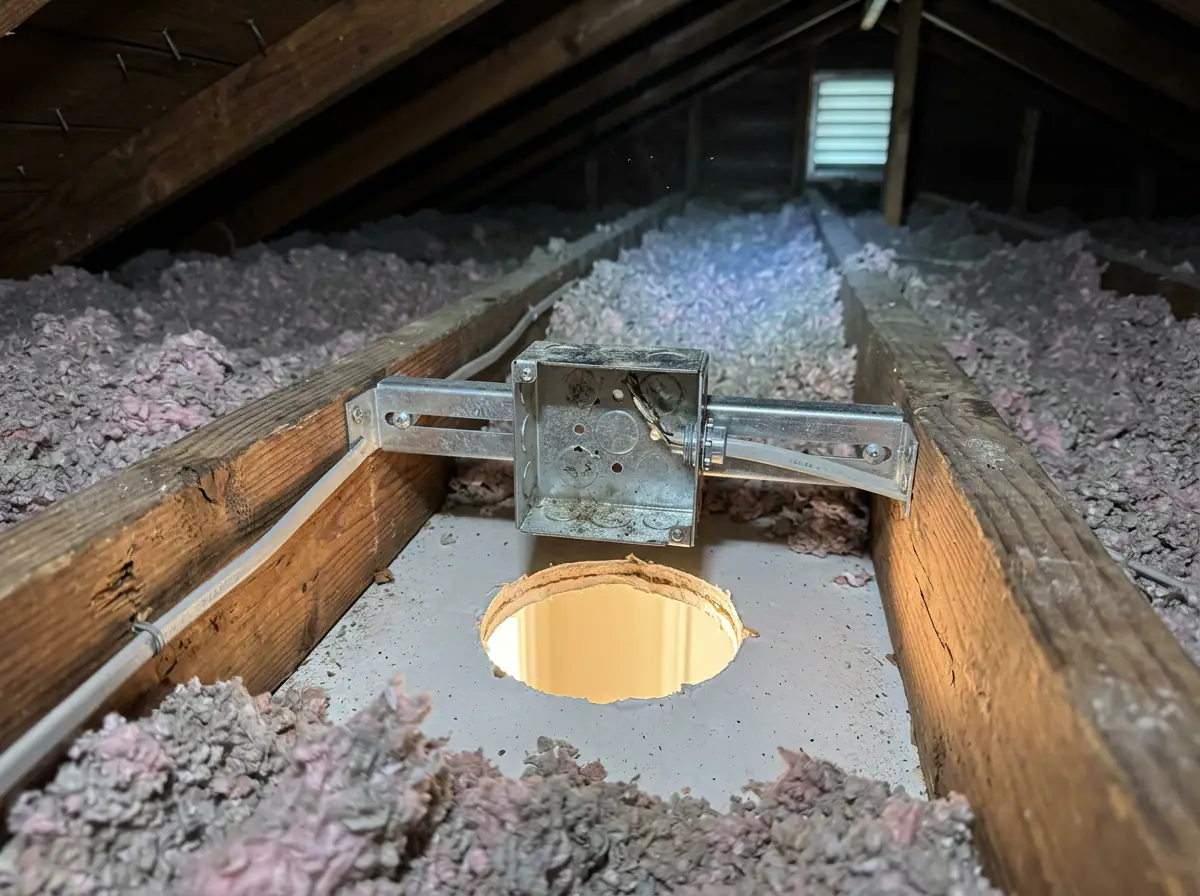
A standard light fixture box is designed to hold a light fixture that sits still. A ceiling fan pulls, twists and vibrates the box every time it spins. If the box is only secured with a couple of small screws into a drywall ceiling, it can loosen over time. In the worst case, the fan can come down.
A fan-rated electrical box is built and labeled to support a moving fan. It also has to be anchored properly to the framing. Depending on your ceiling, that can mean:
- Replacing the existing box with a fan-rated box that fastens to a joist
- Installing a fan brace between joists when the box sits between framing members
- Using attic access, where there is any, to secure the box from above
- Opening a small section of ceiling when there is no access, then patching it
We look at the box before quoting the job when we can, and we tell you plainly if it needs to be replaced. A fan hung on the wrong box is a risk, and we do not install fans that way.
High, Sloped and Vaulted Ceilings
Granbury homes range from older single-story houses to newer builds with tall great rooms. Ceiling height changes how a fan should be installed.
- Downrods: On a tall ceiling, a longer downrod drops the fan to a height where it moves air where people actually sit. A fan hugging a 12-foot ceiling does little for the room.
- Angle mounts: On sloped or vaulted ceilings, the fan needs a mount that allows it to hang straight. Many fans include one, and some require a separate kit.
- Safe access: High ceilings mean ladders, scaffolding or both. Working at that height is part of why these jobs are best left to a professional.
Vaulted ceilings also make it harder to get a new wire up to the fan location, so these jobs may take more time than a standard swap. We explain that in the estimate.
Outdoor Patio Ceiling Fan Installation
Covered patios are common across Hood County, and a fan out there makes a real difference during a Texas summer. But outdoor fans are not the same as indoor fans.
Damp-rated vs. wet-rated fans
A damp-rated fan is made for covered areas that stay protected from direct rain, such as a deep covered porch. A wet-rated fan is made to handle direct moisture and is the better choice for patios open to blowing rain. Using an indoor fan outside leads to rust, swollen blades and electrical trouble. If you are not sure which rating your patio needs, we can look at the space and tell you.
GFCI protection and weatherproof wiring
Outdoor electrical work often involves GFCI protection and weatherproof connections, and what applies depends on your setup and the current code. We check the circuit and install it correctly. You can read more about GFCI protection in our guide to GFCI outlets in Granbury, and our post on outdoor electrical upgrades for patios covers the bigger picture for your outdoor space.
Ceiling Fan Repair in Granbury
Not every fan problem means a new fan. Some are quick fixes, and some point to something behind the ceiling. For ceiling fan repair Granbury homeowners call us about, here is what we usually find.
Wobbling fans
Wobble can come from unbalanced blades, loose blade screws or a bent blade holder. It can also come from a loose or undersized box. If tightening and balancing do not solve it, we check the mounting. A wobbling fan on a poor box is not something to ignore.
Humming or buzzing
A hum often points to the wrong control. A standard light dimmer on a fan motor is a common cause. It can also come from a loose part inside the fan housing or a failing capacitor.
Fan not turning on
This could be a bad switch, a failed capacitor, a loose connection in the canopy, a faulty pull chain or a tripped breaker. We test the circuit first so we know where the problem is before replacing anything.
Dead light kit
If the fan runs but the lights do not, the problem may be a bulb type the kit cannot use, a bad socket, a failed light kit or a wiring fault between the fan and the switch.
Remote or receiver problems
Remote-controlled fans use a receiver in the canopy. When the remote stops working, the receiver, the batteries or the pairing is usually the culprit. We can often replace the receiver or convert the fan to a wall control.
When a repair is not worth it
Sometimes ceiling fan replacement makes more sense. If the motor is failing, the fan is badly damaged or parts are no longer available, we will tell you straight. If a fix costs close to what a new fan would, we will say so, and you decide.
Switches and Controls: Why the Wrong One Causes Trouble
A fan motor is not like a light bulb. A standard light dimmer is built to control lighting loads, and it can make a fan motor hum, run hot or fail early. Fans need a control designed for them.
- Fan speed control: A wall control made for fan motors lets you set speed without damaging the motor.
- Separate fan and light controls: If the fan has a light kit, you may want to run the two on separate controls, including dimming for the light only when the kit supports it.
- Smart controls: Many homeowners want app or voice control. We install smart controls that work with your fan, and we check compatibility first so you do not buy a control that cannot run your model.
If the circuit itself is overloaded or you are adding fans to a new room, we may also look at whether a dedicated line makes sense. See our circuit installation page for how that works.
What Affects the Price of a Ceiling Fan Install
We do not quote a flat number over the phone because fan jobs vary a lot. Here is what moves the price:
- Existing wiring and box: A fan-rated box already in place makes for a simpler job than a swap that needs a new box and bracing.
- Ceiling height: Tall or vaulted ceilings take more time and equipment.
- Attic access: Easy attic access makes running wire and securing a box simpler. No access can mean more labor.
- New switch runs: Adding a wall control or a switch for a new location takes more wiring.
- Who supplies the fan: You can buy the fan yourself or we can help you pick one. Tell us which when you call.
We give upfront estimates so there are no surprises, and we avoid the kind of shortcut that leads to expensive rework later.
Serving Granbury, Tolar, Cresson, Stephenville and Weatherford
If you searched for ceiling fan installation near me and you are in our area, we can come to you. Our home base is Granbury, and we serve Tolar, Cresson, Stephenville and Weatherford, along with other nearby communities. You can learn more about our work in Cresson and Stephenville on our local pages. To learn more about who will be at your door, visit our about page. We work under Texas Electrical Contractor License 40771, and we are a licensed electrician team that stands behind our work.
Ceiling Fan Installation FAQ
How long does a ceiling fan installation take?
It depends on the job. A swap where a fan-rated box and wiring are already in place is typically quicker than a new location, which needs wiring, a new box and a switch. Tall ceilings and limited attic access add time. We give you a realistic timeframe when we quote.
Can a ceiling fan be installed where there is no fixture?
Yes, in most cases. We run power to the new spot, install a fan-rated box with proper support and add a switch or control. The route for the wire depends on your attic and ceiling, which is why we like to see the space first.
Do you install fans that I bought myself?
Yes. We install customer-bought fans. Let us know the brand and model when you call so we can check that it suits your ceiling height, the box and any controls you want to use.
What should I do if my ceiling fan wobbles?
Turn it off and avoid running it until it is checked. Light wobble can come from loose blade screws or unbalanced blades. If it continues, or the fan seems to move at the ceiling, the box or mounting may be the problem, and that needs a licensed electrician to look at it.
Book Your Ceiling Fan Installation or Repair
If you want a fan hung safely, a wobbly one fixed or a new fan added where none exists, Revamped Electric is ready to help. Call us at 817-677-0036 or use our contact page to book a ceiling fan installation or repair. When you reach out, tell us whether you already have the fan and whether there is an existing fixture in the spot, so we can quote accurately. We will take it from there.