
You flip a switch in the kitchen and nothing happens. The living room lights are fine, but the bedrooms are dark, the dryer is dead, and the AC is not running. If you are dealing with half of house no power, you are not imagining things, and you are not alone. A partial power outage in a house is one of the more confusing electrical problems because it looks like a tripped breaker one minute and like something much bigger the next.
We are Revamped Electric, a veteran-owned electrical contractor in Granbury, TX. Owner Austin Barrett is a U.S. Navy veteran, and co-owner Nick Torres is a Granbury native. We get calls about this problem from Hood County homeowners, and the first thing we tell them is to stay calm and work through a short, safe triage. This guide walks you through it.
Half of House No Power: Why It Happens
Most homes in Granbury, Tolar, Cresson, Stephenville and Weatherford get what is called 240V split-phase service. Two energized wires, often called legs, come into your home along with a neutral conductor. Each leg supplies 120 volts to its half of the circuits in your panel. Big appliances like the AC, electric dryer and range use both legs together to make 240 volts.
Your lights and most outlets use one leg plus the neutral. That is why losing one leg can leave you with a partial outage: the circuits on the dead leg go dark, and the circuits on the working leg keep running. A problem can start in one of three places:
- Inside the house: a tripped breaker, a tripped GFCI, or a loose connection at a breaker or outlet.
- At the panel or service entrance: a failed main breaker, a bad connection at the meter base, or damaged service entrance cable.
- On the utility side: a damaged service drop, a failed connection at the pole or transformer, or a lost leg or open neutral upstream of your meter.
The goal of the next few minutes is to figure out which bucket you are in.
Safe First Checks You Can Do in 5 Minutes
These checks are safe for any homeowner. You will not need tools, and you will not remove any covers.
1. Look for a tripped or half-tripped breaker
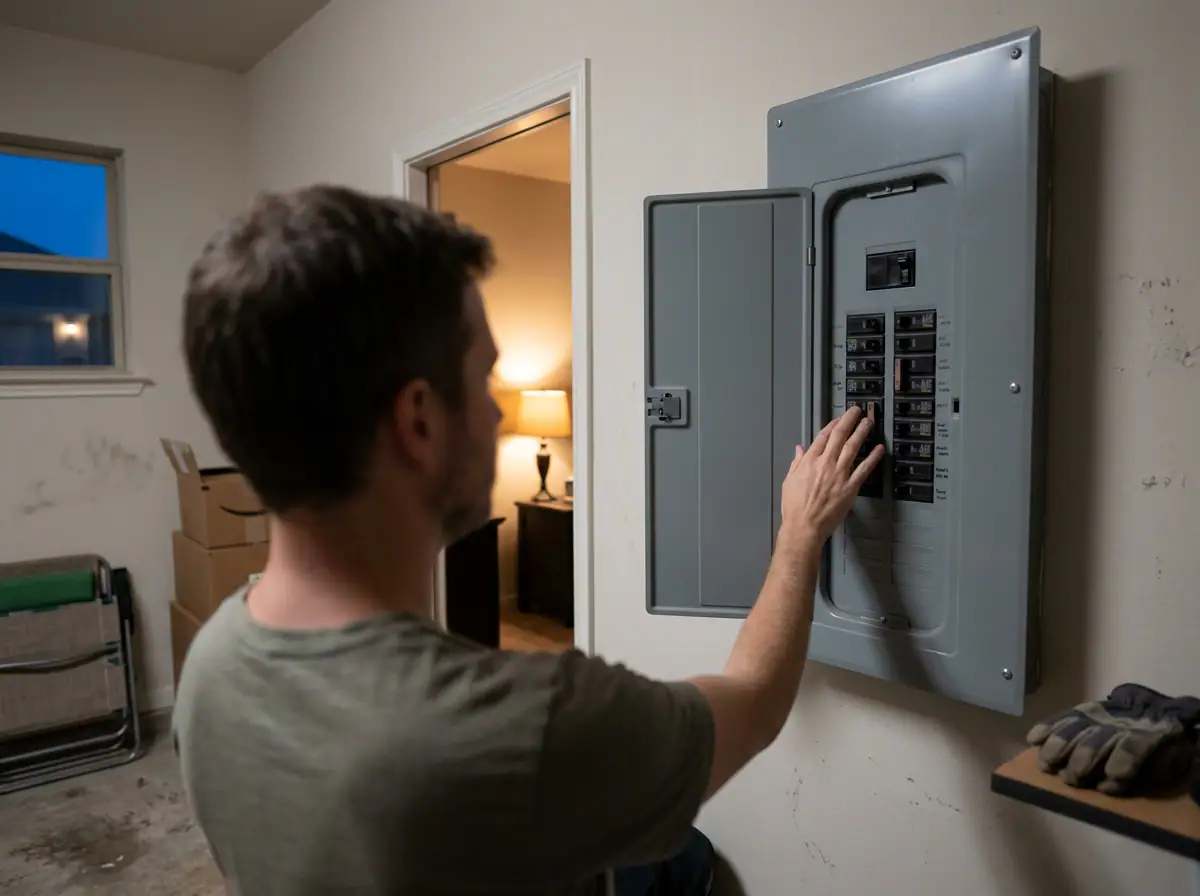
Open the hinged door on your panel and look at the breaker switches. A tripped breaker often sits in a middle position, not fully on or fully off. To reset one, push it firmly to OFF, then back to ON. If it trips again right away, do not keep resetting it. Our guide on breaker trips explains why that matters.
Pay attention to double-pole breakers, the wide ones with two switches tied together. They feed 240V loads like the AC, dryer and range. If one of those trips, that appliance dies while your lights stay on.
2. Check the main breaker
The main breaker is the large one at the top of the panel, or in a separate disconnect near the meter. A standard main is a double-pole breaker that feeds both legs. If it is tripped, the whole house would normally be dark, so a partial outage usually points elsewhere. If you do find it tripped, switch off the big loads in the house first, then push it fully off and back on once. If it will not stay on or trips again, stop and call. Never open the metal inner cover of the panel to investigate.
3. Reset your GFCIs
One tripped GFCI can knock out several outlets downstream, and the failed outlets are often in a different part of the house from the GFCI. Check the garage, bathrooms, kitchen, laundry area and outdoor outlets, and press RESET on each. Our post on GFCI outlets covers where they hide. If you want a broader checklist, see electrical troubleshooting 101.
4. Ask your neighbors
Look outside. If the neighbors are dark too, or you can see a downed line or a transformer problem, report it to your electric provider right away. Stay far away from any downed wire.
Lost One Leg of Power: The Signs
If every breaker and GFCI looks fine and you still have a power outage in half of the house, a lost leg is a strong suspect. Typical signs include:
- Some lights and outlets work and others do not, in no obvious room-by-room pattern.
- 240V appliances such as the AC, dryer, range or water heater stop working or act strangely.
- Breakers in the panel look normal, with nothing tripped.
A lost leg usually points to the service drop, the meter base, the service entrance cable or the utility connection. Those parts are often outside your home, so a reset will not fix it. Do not try to test or touch the meter base or the wires entering your house.
Loose Neutral Symptoms: Treat This as Urgent
A loose or failed neutral is different, and it is more dangerous. The neutral conductor lets the two halves of your house share the load and keeps voltage balanced. When it is loose or broken, the voltage on one side of the house can climb too high while the other side drops too low. Common loose neutral symptoms include:
- Lights dim on one side of the house while lights on the other side get unusually bright.
- Lights flicker or change brightness when a large load, like the AC or a well pump, starts.
- Electronics or appliances act up, buzz, or run hot.
- A burning smell, or warm or buzzing outlets or panel parts.
If you see these signs, act now. Turn off and unplug sensitive electronics and appliances if you can do so safely, avoid running large loads, and call your electric provider and an electrician immediately. If you smell burning or see smoke or sparks, leave the house and call 911. Our article on emergency electrical situations lists what to do while you wait for help.
Who to Call: Utility or Electrician?
This is where many homeowners lose time. The split usually looks like this:
- Call your electric utility or electric cooperative for problems with the service drop (the wires from the pole to your house), the transformer, or the meter itself. They own and work on that equipment.
- Call an electrician for the meter base, service entrance cable, main breaker, panel and house wiring. Those parts belong to the homeowner.
How to find your provider in Hood and Parker County
We are not going to guess which utility serves your address. Service territories do not always follow city limits, and in Granbury, Tolar, Cresson, Stephenville and Weatherford the provider can depend on the exact street. Here is how to find yours quickly:
- Check your electric bill. The outage or customer service number is usually printed on it.
- Look at your meter for a company name or logo.
- Keep in mind that in much of Texas, the company that bills you may not be the company that owns the poles, wires and meter. If you are unsure, your bill or your provider's website will tell you who to call for outages and line problems.
Save that number in your phone before the next storm. If you are not sure whether the problem is yours or the utility's, call us anyway and we will help you sort it out.
After Storms and Texas Heat
North Texas weather is hard on electrical service. High winds can damage or pull on the service drop, loosen the connection at the weatherhead, or knock limbs onto the lines. If your power went partial right after a storm, mention that to the utility and to us.
Summer heat creates its own problems. Long AC run times put heavy loads on connections, and a connection that is loose, overloaded or corroded can overheat and fail. Older homes can have extra risk, especially with aging panels or aluminum branch wiring. If your home is older, our guides on panel upgrade warning signs and aluminum wiring are worth a read.
What Not to Do
- Do not remove the panel's inner cover. The parts behind it stay energized even when breakers are off.
- Do not keep resetting a breaker that trips again. It is telling you something is wrong.
- Do not backfeed a generator through an outlet. It can energize utility lines and seriously hurt a lineworker or a neighbor. A properly installed transfer switch is the safe way, and our post on generator installation and transfer switches explains how it works.
- Do not touch the meter, service drop or any downed wire.
- Do not run big appliances if the lights are dimming and brightening.
What a Revamped Electric Visit Looks Like
When we show up for a partial power loss, we start by listening to what you saw and when it began. Then we work from the outside in. We test voltage at the panel and at the meter base to see whether both legs are present and balanced. We check the main breaker and the connections at the panel, looking for loose, heat-damaged or corroded terminals. We also inspect the meter base and service entrance cable.
If the problem is on the utility side, we tell you plainly so you can get the right company out. If it is on your side, we repair it. If the panel, meter base or service is worn out, we explain the options, including a service or panel upgrade, before any work starts. Revamped Electric holds Texas Electrical Contractor License 40771, and our approach is simple: honor and integrity, do your best work, and help your neighbor.
Half-House Power Loss FAQ
Is a partial power outage in a house dangerous?
It can be. A tripped breaker is usually harmless, but a lost leg or a loose neutral can cause voltage problems that damage electronics and appliances, and a failing connection can overheat. If lights are dimming on one side and brightening on the other, or you smell burning, treat it as urgent.
Why does my AC not work but my lights do?
Your AC runs on 240V, which needs both legs. If one leg is lost, or the AC's double-pole breaker is tripped, the AC can stop while many lights still work. Check the breaker, and if it looks fine, have it diagnosed rather than resetting repeatedly.
Can a bad breaker cause half the house to go out?
Yes. A failed main breaker or a bad connection at the panel can cut one leg. A single failed branch breaker usually affects only its own circuit, though, so a wider outage often points to the main, the meter base or the utility side.
Still Dark? Let Us Take a Look
If the breakers and GFCIs check out and half the house is still dark, or the lights are dimming and brightening, call Revamped Electric at 817-677-0036. We serve Granbury and surrounding towns including Tolar, Cresson, Stephenville and Weatherford. You can read more about our loss of power repair service, or contact us online. Your neighbors at Revamped Electric will help you find out what is going on and get your lights back on safely.