

You plug in a phone charger or a vacuum and nothing happens. An outlet not working is one of the most common calls we get at Revamped Electric, and the cause ranges from a harmless tripped GFCI to a loose connection that needs a licensed electrician right away. The tricky part is that a dead outlet looks the same no matter what is behind it.
This guide walks through six common causes in the order we would check them, starting with things you can safely test in about five minutes. It also covers the warning signs that mean you should stop and call, and what a repair visit actually involves, so you know what to expect.
Outlet Not Working? Start With These Safe 5-Minute Checks
Before you assume the outlet has failed, rule out the three easiest causes. None of these require tools or opening anything up.
Cause 1: It is a switched outlet
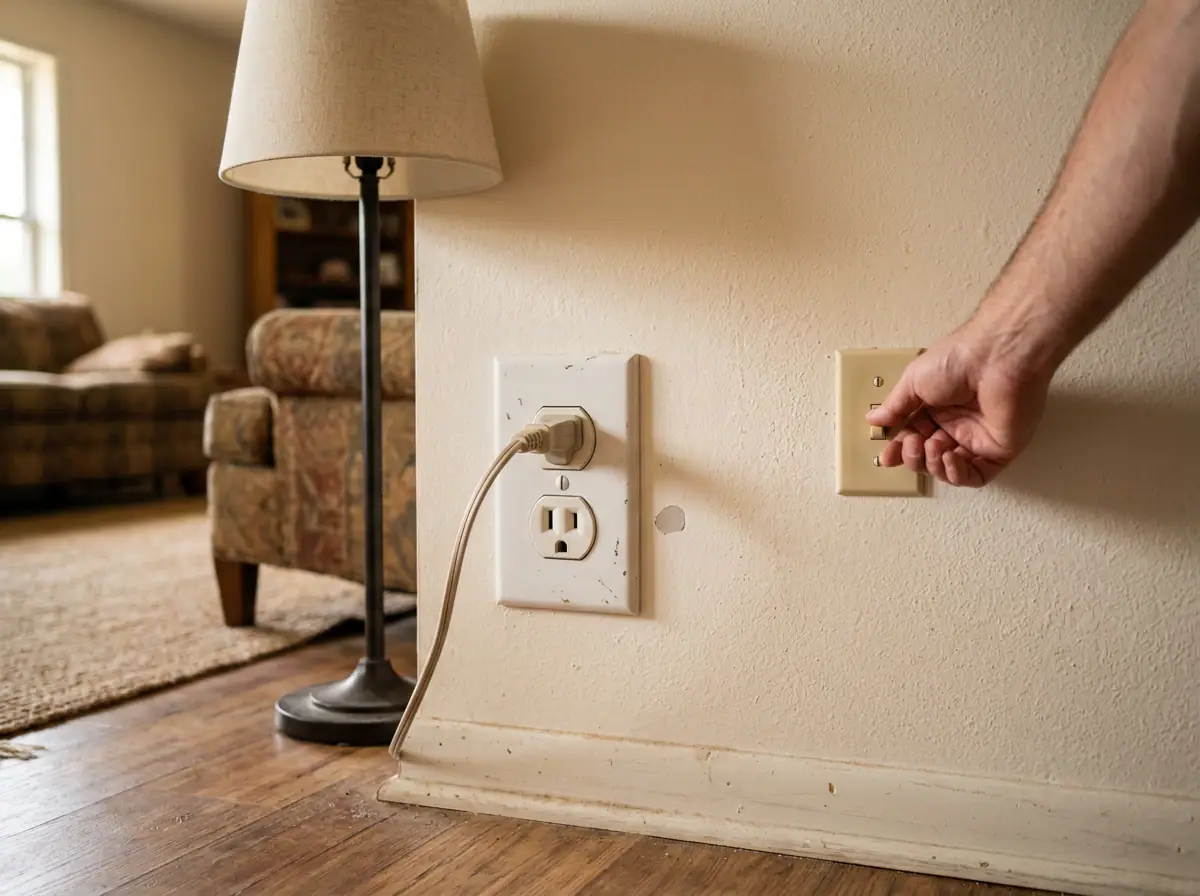
Many living rooms and bedrooms in Hood County homes have one outlet controlled by a wall switch, usually meant for a floor lamp. If the dead outlet is in a room like that, flip nearby switches and test again. A switched outlet that was left off is the simplest fix there is. Plug a lamp in to test, and try the other half of the outlet too, since some are only half switched.
Cause 2: A tripped GFCI somewhere else
A GFCI receptacle protects itself and often other outlets "downstream" on the same circuit. That means the dead outlet in your hallway could be protected by a GFCI in the garage, a bathroom, a kitchen, or on the exterior wall. Look for the TEST and RESET buttons, press RESET firmly, and see whether power returns. If you are not sure where GFCIs belong in your home, our guide to GFCI outlets in Granbury, TX explains where they are required and why.
Cause 3: A tripped or half-tripped breaker
Open your panel and look for a breaker that sits out of line with the others. Sometimes a breaker trips only part of the way, sitting in a middle position that still looks "on." To reset it properly, push it fully to OFF first, then back to ON. If it trips again right away, do not keep resetting it. That points to an overload or a fault, which we cover in our page on breaker trips.
Keep your hands dry, stand to the side of the panel, and never remove the panel cover. If anything about the panel looks scorched, wet or damaged, leave it alone and call us.
Outlet Not Working but Breaker Not Tripped: What Is Going On
If the switch, GFCI and breaker all check out and the outlet is still dead, the problem is usually inside the wiring itself. This is the point where homeowner checks end and professional testing begins. Three causes show up most often.
Cause 4: A loose or failed backstab connection
Many builder-grade receptacles use a backstab connection, where the wire is pushed into a small spring slot on the back instead of being wrapped around a screw terminal. Over years of heat cycles and plugging and unplugging, that grip can loosen. A loose connection can drop power to the outlet, or to everything wired after it, without ever tripping a breaker, because the circuit is simply open. Loose connections can also create heat, which is one reason we do not treat a dead outlet as a "wait and see" problem.
Cause 5: A failed receptacle
Receptacles are mechanical parts and they wear out. The internal contacts can fail, leaving an outlet dead even though power reaches it. If the outlet also feels loose, cracked, or grips plugs poorly, read our breakdown of how to tell if an outlet is worn out. Replacing a failed receptacle is a straightforward repair when the wiring behind it is in good shape.
Cause 6: A failed upstream device or an open neutral
Outlets are fed in sequence. If a device upstream, such as another outlet or a junction splice, has a bad connection, everything after it can go dead. A related issue is an open neutral. Power needs a complete loop to flow, and if the neutral wire has a break or a loose splice, the outlet may have voltage on one wire but no way to complete the circuit. In plain terms, the "return road" is closed. This can cause dead outlets, odd behavior with lights, or partial power loss. When whole areas of a house go quiet, see our article on what half a house with no power means.
Half of an Outlet Not Working: Split-Wired or Failed?
If the top plug works and the bottom does not, or the reverse, there are two likely explanations.
- A split-wired receptacle. An electrician may have deliberately wired one half to a wall switch so a lamp can be controlled from the doorway. This is normal. Flip the switches in the room and see if the dead half responds.
- A failed receptacle. If there is no switch involved, one set of internal contacts may have failed or a connection may have loosened. This is a common reason for a half-dead outlet, and replacement is typically the fix.
A tip for your visit: tell us whether the outlet has always worked this way. A half-switched outlet that has "always been like that" is fine. One that changed suddenly deserves a look.
Multiple Outlets Not Working in One Room
When several outlets die together, the cause is almost never several failed outlets. Many homes, especially older ones around Granbury, Tolar and Cresson, are wired in a daisy chain: power runs from the panel to the first outlet, then onward to the next, and so on. If one connection in the chain comes loose, every outlet after it loses power.
That is why the dead outlets in a room often seem to follow a pattern. The failing point is usually the last working outlet before the dead ones, or a splice hidden in a box nearby. Tracing the circuit is how a technician finds it, starting at the last outlet that works and testing forward.
If the dead area spans multiple rooms, or lights are affected too, read about the signs of faulty wiring, because the cause may be farther upstream.
GFCI Outlet Won't Reset: Moisture, Ground Fault or End of Life
A GFCI outlet that won't reset is a different problem from a dead standard outlet. A GFCI monitors current and shuts off when it detects a leak to ground. There are three typical reasons it will not reset.
- Moisture. Exterior outlets, garage outlets and boat dock outlets near Lake Granbury see rain, sprinklers, humidity and condensation. Water inside a weatherproof cover or box can keep tripping the GFCI. Letting things dry sometimes allows a reset, but repeated trips mean water is getting somewhere it should not.
- A real ground fault. A damaged cord, a failing appliance, or a nicked wire downstream can leak current. Unplug everything on the circuit and try a reset. If it holds, plug devices back in one at a time to find the culprit.
- End of life. GFCI devices wear out. If the unit will not reset with nothing connected, or the test button does nothing, it likely needs replacement.
Be careful with dock and waterfront outlets. Water and electricity are an unforgiving combination, and a GFCI that keeps tripping is protecting you. Do not bypass it or swap it for a standard outlet.
Stop and Call: Signs a Dead Outlet Is a Safety Problem
Everything above assumes the outlet is merely dead. These signs mean something more serious is happening, and you should stop using the outlet and call a licensed electrician:
- A faceplate or plug that feels warm or hot
- Scorch marks, discoloration or melted plastic
- Buzzing, crackling or sizzling sounds
- A burning or fishy plastic smell
- Sparks when plugging something in
- A breaker that trips immediately every time it is reset
If you smell burning or see smoke, leave the area and call 911 first. Turn off the breaker only if it is safe to reach it.
Another stop sign is the age and wiring type of your home. Houses built in the 1960s and 1970s sometimes have aluminum branch wiring, which is more prone to loose, overheated connections at outlets and switches. If your home has it and you have any dead or warm outlets, read our guide to aluminum wiring in older homes. This is not a DIY repair, because the wrong receptacle or connector can make the situation worse.
It is also worth knowing that an AFCI breaker, found in many newer homes, is designed to trip when it detects arcing. If an AFCI breaker keeps tripping, that is a warning worth investigating rather than silencing.
What a Repair Visit Actually Involves
People often put off the call because they do not know what the visit will look like. Here is how a typical dead-outlet repair goes with Revamped Electric:
- Questions and history. When did it stop working, what else is affected, and did anything trip or smell odd?
- Testing. We check voltage, polarity, grounding and GFCI function with proper meters, not guesswork.
- Inspecting the receptacle. With power off, we look for loose terminals, heat damage, backstab failures and worn contacts.
- Tightening or replacing. Depending on what we find, that means securing connections, moving wires from backstabs to screw terminals, or installing a new receptacle. If you want upgrades while we are there, see our outlet installation options.
- Tracing the circuit. If the outlet itself is fine, we follow the circuit upstream, checking the previous outlets and splices to find the open connection.
- Verification. We confirm power, polarity and protection are correct before we leave, and explain what we found in plain language.
As a veteran-owned company, we believe in clear communication and no surprises, so you will know what the problem is and what it takes to fix before work begins. You can see everything we handle on our services page.
Outlet Not Working: Quick FAQ
Can a bad outlet trip a breaker?
Yes. A failing receptacle, damaged wiring or a loose connection that arcs can cause a breaker to trip. An outlet that trips the breaker every time it is used needs to be inspected rather than reset repeatedly.
Is a dead outlet dangerous?
Not always. A switched outlet or tripped GFCI is harmless. But a dead outlet caused by a loose or burned connection can be a fire risk, especially if it is warm, discolored or smells like burning.
Why is my outlet not working but the breaker is not tripped?
Common causes are a tripped GFCI elsewhere on the circuit, a loose backstab connection, a failed receptacle, or an open connection upstream. Only testing can tell which one it is.
Why won't my GFCI outlet reset?
Moisture, a ground fault from something plugged in downstream, or a worn-out GFCI are the usual reasons. Unplug everything first. If it still will not reset, the device likely needs replacing.
Can I replace an outlet myself?
Replacing a receptacle involves working with live circuits and wiring that may be loose, aluminum or improperly spliced. If the cause is unclear, it is safer and often faster to have a licensed electrician diagnose it.
When the Outlet Is Still Dead, Call Revamped Electric
If you have checked the switch, the GFCI and the breaker and the outlet is still dead, or you notice heat, scorch marks or a burning smell, stop using it. We serve homeowners across Granbury and Hood County, including Tolar and Cresson, and also work in Stephenville and Weatherford.
Call Revamped Electric at 817-677-0036 or request a repair visit through our contact page. If you can, send a photo of the outlet and the nearest GFCI receptacle. It helps us diagnose the issue faster and show up prepared. If your outlet stopped working in Granbury, TX, we will find out why and make it right.