
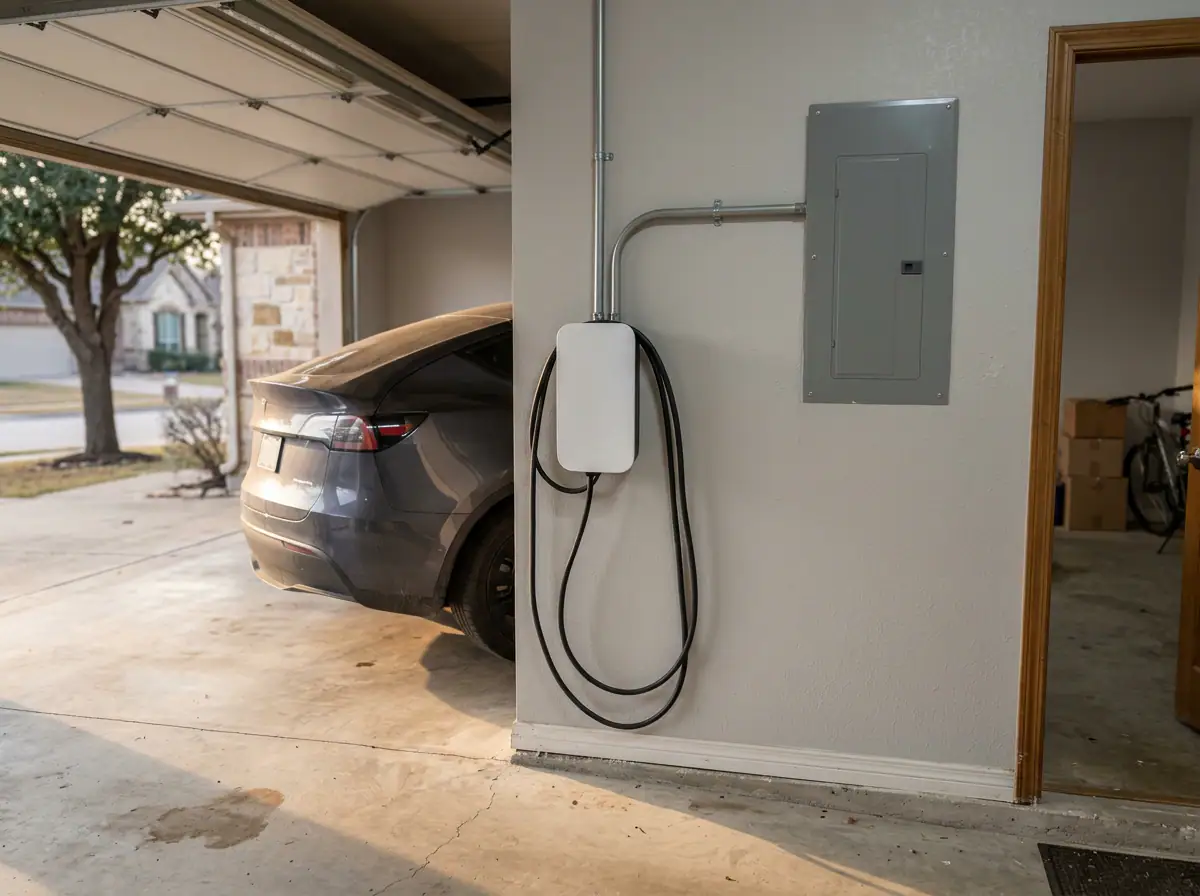
If you are looking into EV charger installation Granbury TX homeowners can count on, the first question is rarely "which charger should I buy?" It is "can my house actually handle one?" That is the right question to ask, and it is the one we answer before you spend a dime on hardware. At Revamped Electric, we look at your panel, your loads and your parking spot first, then design a safe 240-volt dedicated circuit around what we find.
This page walks through how a home EV charger install works, what changes the scope of the job, and what to expect from start to finish. If you want more background reading, our earlier guides on what homeowners need to know before going electric and how to prepare your home for an EV charger go deeper on specific pieces.
EV Charger Installation in Granbury, TX: What the Job Actually Involves
A home EV charger install is really a new circuit installation with a charger on the end of it. The work usually breaks down like this:
- Site visit or photo review: We look at your electrical panel, the available breaker spaces, and where you park.
- Load calculation: We confirm your service can carry a new high-demand circuit.
- Circuit and wire run: We install a 240-volt dedicated circuit with the correct breaker, wire size and protection.
- Charger or outlet mounting: We install a hardwired EV charger or a NEMA 14-50 outlet, depending on the plan.
- Permit, inspection and testing: We make sure the work meets code and the charger operates as it should.
Revamped Electric is a veteran-owned, licensed Texas electrical contractor (license 40771) based right here in Granbury. Owner Austin Barrett, a U.S. Navy veteran, and co-owner Nick Torres, a Granbury native, bring the same discipline to a garage charger that they bring to any panel or service job.
Level 1 vs Level 2 Charging: Why Most Granbury Homeowners Choose Level 2
Level 1 charging uses a standard 120-volt household outlet. It works in a pinch, but it adds range slowly. If you drive a lot around Hood County, commute toward Fort Worth, or run errands across the lake area, overnight Level 1 charging may not keep up with your daily miles.
A Level 2 charger runs on 240 volts, the same type of power an electric dryer or range uses. It charges much faster, which is why Level 2 charger installation is the most common request we hear. Charging speed depends on your vehicle and the circuit amperage, so we size the circuit to match what your car can accept and what your panel can safely supply.
Hardwired EV Charger vs NEMA 14-50 Outlet
This is the next decision, and neither option is always right. Here is how we think about it.
Hardwired EV charger
A hardwired EV charger connects directly to the circuit with no plug. That removes a common failure point, since loose or worn plugs and receptacles can overheat under long, continuous loads. Hardwiring is often the cleaner choice for a permanent setup, and many wall-mounted units, including the Tesla Wall Connector, are designed to be wired this way. The tradeoff is less flexibility if you move or swap chargers later.
NEMA 14-50 outlet
A 240v outlet for EV charger use, typically a NEMA 14-50 outlet, lets you plug in a portable charging cord. It is flexible, and it can serve a welder, RV or other 240-volt equipment later. The downsides are plug wear over time and the need for a high-quality, properly rated receptacle with correct GFCI protection where required. If you plan to charge nightly for years, we often lean toward hardwiring. If you want flexibility, a well-installed outlet makes sense.
Either way, the circuit itself matters most. Because EV charging is a continuous load, the National Electrical Code (NEC) requires the circuit to be sized with extra headroom above the charger's rated draw. That is one reason we never guess at breaker or wire size.
Can My Panel Handle It? Load Calculation and Panel Capacity
This is the heart of the job. A load calculation is how we figure out whether your existing service has room for a new dedicated EV circuit. We typically work through it in this order:
- Check the service size. We read the main breaker rating and the panel's labeling and condition.
- Add up existing loads. Air conditioning, electric range, dryer, water heater, pool equipment, a workshop and anything else that draws heavy power all count.
- Choose the charger amperage. A higher-amperage charger charges faster but asks more of the panel. Sometimes a lower setting is the smarter fit.
- Apply NEC methods. We use code-based calculation methods rather than eyeballing it.
- Decide the path. The result is usually one of three: your panel has room, your panel can work with a load management approach, or you need an electrical panel upgrade or subpanel.
Older Granbury homes are where this gets interesting. Some have smaller service sizes, full panels with no open breaker spaces, or equipment that is past its prime. If your breaker box shows signs of age, our guide to signs your breaker box is overdue for a change is a good place to start, and our panel changes page explains how we handle upgrades. For a broader look at household demand, see how to tell if your home's electrical system can handle new appliances.
The good news: plenty of homes do not need a full upgrade. But you want to know that before you buy a charger, not after.
Where the Charger Goes: Garage, Driveway, Detached Shop
Location changes the wire, the labor and sometimes the permit scope.
- Attached garage: Usually the simplest. The panel is often close, and the run is short.
- Driveway or exterior wall: Needs weather-rated equipment and proper outdoor mounting. Texas sun, wind and storms are hard on poorly chosen gear.
- Detached garage or shop: Often means a feeder to a subpanel, possibly with conduit and trenching. Our guide to garage and workshop electrical upgrades covers what powering that space involves.
Longer runs change more than the length of wire. As distance grows, we may need a larger conductor to limit voltage drop, and that affects both materials and labor. It is also a good moment to think about future needs, like a second vehicle or shop equipment, while the trench is open. A dedicated circuit installation is easier to plan once than to redo later, and this explanation of dedicated circuits shows why high-demand equipment should not share power.
What Drives EV Charger Installation Cost
We do not publish a one-size price because EV charger installation cost depends on your house. These are the factors that move the number:
- Charger type: A hardwired unit and a plug-in outlet setup have different equipment and labor needs.
- Amperage: Higher-amperage circuits need heavier wire and larger breakers.
- Distance from the panel: Short garage run versus a long run to a driveway or shop.
- Panel capacity: A panel with room costs less than one that needs an upgrade or subpanel.
- Trenching and conduit: Needed for many detached or outdoor installs.
- Permit and inspection: A permitted install is part of doing the job right.
We provide a quote after we see your panel and your parking location, so there are no surprises midway through the work.
Permits, Inspection and Why They Matter
A new 240-volt circuit is the kind of work that generally calls for a permit and inspection. Requirements can vary by jurisdiction within Hood County and surrounding areas, so we confirm what applies to your address before we start. A permitted, inspected install matters for a few practical reasons. It shows the work met code, it supports your homeowner's insurance if there is ever a claim, and it gives a future buyer confidence when you sell. An unpermitted charger circuit can become a headache at resale or after a loss.
Chargers We Install
We install the charger that fits your vehicle and your home, including the Tesla Wall Connector. A Tesla Wall Connector installation follows the same process as any hardwired unit: confirm capacity, size the circuit, mount and wire it, and test. If you already own or are considering another charger, send us the model and we will confirm it works with the circuit we plan. We install equipment but do not claim manufacturer certification for any brand.
Service Area: Granbury, Tolar, Cresson, Stephenville and Weatherford
If you have searched for EV charger installation near me, here is where we work:
- Granbury: Our home base, with a mix of lake-area homes and newer neighborhoods, which means panels of very different ages.
- Tolar: Rural-style properties are common, so detached shops and longer runs come up often.
- Cresson: Larger lots mean we plan driveway and outbuilding charging carefully.
- Stephenville: A longer drive for us, so we schedule visits thoughtfully and review panel photos ahead of time.
- Weatherford: A blend of established homes and newer builds, each with its own panel considerations.
EV Charger Installation FAQ
Do I need a panel upgrade for an EV charger?
Not always. It depends on your service size, existing loads and the charger amperage. A load calculation tells us whether your panel has room, needs load management, or needs an upgrade.
How long does an install take?
A straightforward install with a short run and an adequate panel is often finished in a single visit. Panel upgrades, long runs, trenching or permit scheduling add time.
Can I use my dryer outlet to charge my EV?
A dryer circuit is a different outlet and amperage than a NEMA 14-50, and it is already serving the dryer. Sharing it is not something we recommend. A dedicated circuit is safer and more reliable.
Should I choose a hardwired charger or a NEMA 14-50 outlet?
Hardwired is often best for permanent, daily charging. A NEMA 14-50 outlet suits homeowners who want flexibility. We help you pick based on how you drive and park.
Do EV charger circuits need GFCI protection?
In many cases, yes. GFCI protection requirements depend on the equipment and the NEC edition in use, and we build the circuit to meet them.
Do I need a permit?
Generally, yes for a new 240-volt circuit. We confirm local requirements for your address and handle the process.
Get the Panel Answer Before You Buy the Charger
Going electric should feel exciting, not like a gamble on your home's wiring. Our approach is simple: find out what your panel can do, pick the right circuit and charger type, and install it to code. Learn more about our veteran-owned team, then call 817-677-0036 or request a quote through our contact page. Send a photo of your electrical panel and where you park, and we will tell you whether you need a panel upgrade before you buy a charger.