

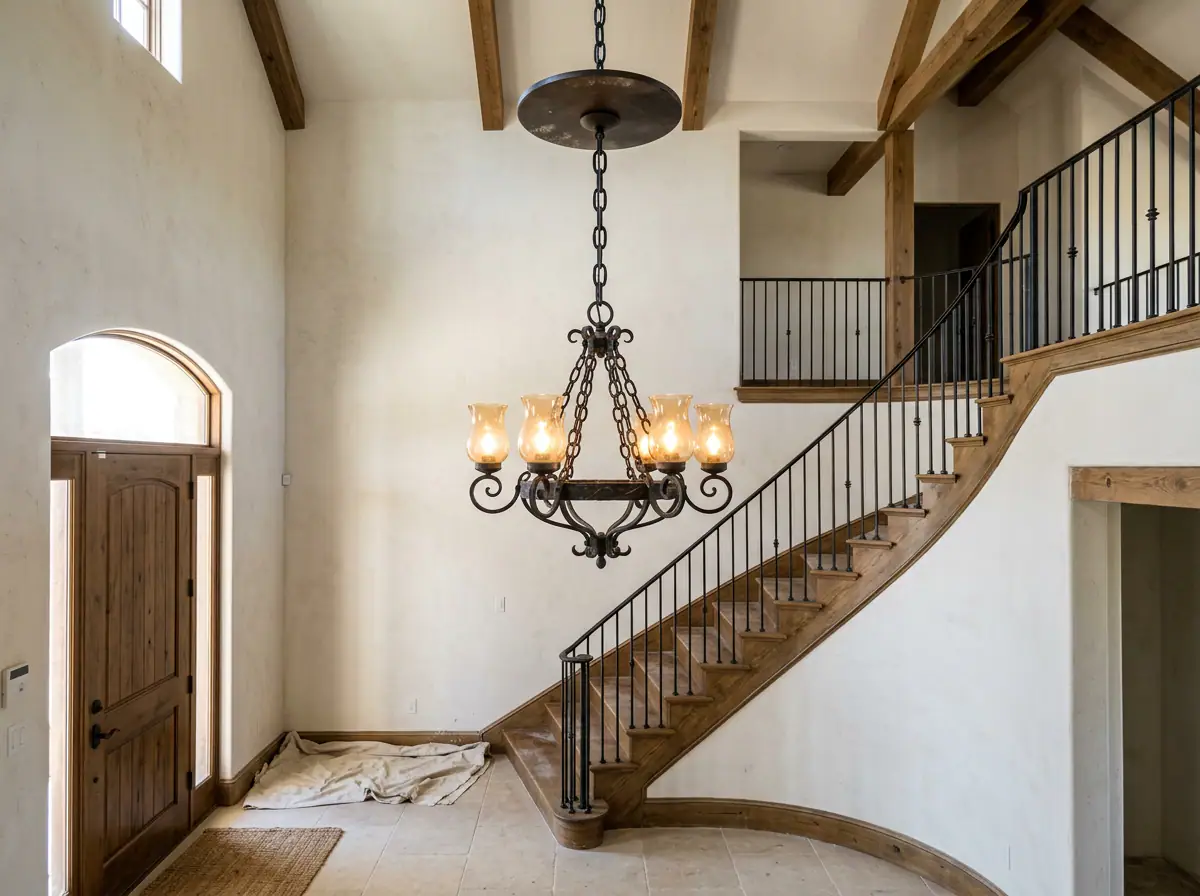
A chandelier looks like a decorating decision, but the moment it leaves the box it becomes a structural one. Heavy glass, iron or wood hangs from a single point in your ceiling for years, often over a dining table or a staircase. That is why chandelier installation in Granbury, TX is a job we recommend leaving off the ladder. The fixture is only half the story. The ceiling box, the wiring behind it and the height you are working at decide whether the job is safe.
This page explains what we check before we hang anything, how tall foyers and stairwells change the work, and when a homeowner should hand the job to a licensed electrician. If you are looking for recessed lights, outdoor lighting or ceiling fans, we link to those pages below so you can go straight to the right place.
Chandelier Installation Granbury TX: Services for Hood County Homes
Revamped Electric is a veteran-owned electrical contractor based in Granbury. Owner Austin Barrett and co-owner Nick Torres handle fixture work for homeowners across Hood County and the surrounding area. For hanging fixtures, the work usually falls into three types:
- New installs. A chandelier you bought for a dining room, entryway, primary bedroom or stairwell, hung where a fixture already exists or where you want it moved.
- Replacements. Swapping an outdated brass fixture, a builder-grade light or a damaged chandelier for something new, including heavier replacements that need extra support.
- Adding a fixture where none existed. This means running new wiring, installing a fixture-rated box and adding a switch or dimmer so the light works the way you expect.
We also handle general light fixture installation in Granbury, including pendants over islands, flush mounts, semi-flush fixtures and multi-light fixtures. For the broader lineup of lighting work, including recessed cans and dimmers, see our lighting installation page. This page is for the jobs where weight, height or an uncertain ceiling make the install more than a quick swap.
Why the Ceiling Box Matters More Than the Fixture
When a homeowner asks about a heavy light fixture installation, the first question is rarely about the fixture. It is about what is holding it up. Many ceiling boxes in older Granbury homes were set for a lightweight dome light. They were never meant to carry a chandelier.
Fixture-rated boxes and the National Electrical Code
The National Electrical Code (NEC) requires that a luminaire be supported securely, and that the box carrying it be listed for the load. In plain terms, the box has to be rated for the weight of the fixture, and it has to be anchored to the framing, not just screwed to drywall or a thin ceiling surface. The box label and the fixture's stated weight are what we compare. We do not guess, and we do not trust a box simply because it has held a lighter fixture for years.
A fan box is not a chandelier mount
People often assume that if a box can hold a ceiling fan, it can hold anything. Not quite. A fan-rated box is built to handle the motion and vibration of a spinning fan. A chandelier is a different kind of load: steady, concentrated weight hanging from one point, often on a chain or stem, sometimes with a long drop. The box has to be listed for that use, and the mounting hardware has to match the way the fixture hangs. We check the listing and the anchoring, not just the shape of the box. If you are deciding between a fan and a fixture for a room, our guide on ceiling fan and light fixture installation walks through the differences.
When a ceiling brace or independent support is needed
If the existing box is not rated for the fixture, or sits where it cannot be anchored well, the fix is usually a ceiling brace or independent support. A brace is a bar that spans between joists, giving a fixture-rated box a solid structural anchor. Heavier fixtures can also be supported independently from framing, with the box handling only the electrical connections. Which option fits depends on the fixture weight, joist spacing and what we find above the ceiling. Attic access makes this far easier. In rooms with finished space above, we may need to plan the support differently.
High Ceiling Light Fixture Installation: Foyers, Stairwells and Vaulted Rooms
Height changes everything about the job. A chandelier in an eight-foot room is a one-person install. The same fixture in a two-story entry means working well above the floor with a heavy, awkward object in your hands. Foyer and stairwell lighting is where we see the most ladder accidents waiting to happen.
- Access equipment. Tall entries and stairwells often call for scaffolding, a platform or a lift rather than a ladder. Stairs add uneven footing, so the setup has to be planned before the day of the install.
- Chain and canopy length. Hanging height changes how the fixture looks from the floor and from the upstairs landing. We confirm chain length, stem length and canopy size so the fixture is not floating too high or sitting awkwardly low.
- Centering. In a foyer, a fixture that is a few inches off center is obvious as soon as someone walks in. We measure to the room, the staircase and the entry, not just to the existing box.
- Switching. Hard-to-reach fixtures should be easy to control. Three-way switching at the top and bottom of a staircase is a common addition, and a dimmer helps a large fixture feel right at night.
- Bulb access. A fixture hung at the top of a two-story space is a pain to relamp. LED lamps help, and so does choosing a design that lets you reach the bulbs with a lowering mechanism or a simple plan for maintenance.
For homeowners planning a whole-room layout, our home lighting design guide covers how a chandelier fits with ambient, task and accent lighting.
Swapping an Old Fixture: What We Check Before Reusing Anything
Replacing a fixture in an older home is where surprises show up. Once the old light comes down, we look at the whole connection before the new one goes up:
- The box itself. Is it plastic, metal, cracked or loose? Is it anchored to framing? Is it rated for the new fixture's weight?
- The wiring. We look for brittle insulation, scorched wire ends, loose connections and signs of overheating. Fixtures that ran hot or were crammed into small boxes can leave damage behind.
- Grounding. A metal chandelier needs a proper equipment ground. Older homes sometimes have no ground at the ceiling, or a ground that was never connected. Our article on electrical grounding and bonding explains why this matters.
- Conductor type. If we find aluminum branch wiring, we stop and plan the connection properly. See our guide to aluminum wiring in older homes for why it needs special handling.
- Fixture ratings. We check that the new fixture is rated for the number and type of lamps and for the location, and that the wire inside the fixture suits the connection.
If anything fails that check, we fix it before the new fixture goes up. Hanging a beautiful chandelier on a questionable box just moves the problem to a more expensive spot.
Dimmers and LED Compatibility for Chandeliers
Many chandeliers now use integrated LED or small LED candelabra lamps. They look great, but they are picky about dimmers. An older dimmer designed for incandescent bulbs can cause flicker, buzzing, a limited dimming range or lights that never fully turn off.
LED dimmer compatibility depends on the dimmer type, the total load, and the way the lamps or driver are built. We match the dimmer to the fixture, test the range and adjust so the light dims smoothly without buzzing. If you are already seeing odd behavior in your home, our post on lights flickering in the house explains the common causes and when it points to something beyond the dimmer. For ideas on how to layer dimmable lighting across a home, see our piece on custom lighting upgrades for Granbury homes.
What Affects the Price of Chandelier and Fixture Installation
Every home is different, so we quote by the job rather than a flat number. These are the factors that move a fixture install from simple to involved:
- Fixture weight and size. Heavier fixtures usually need stronger support and more hands.
- Ceiling height. Tall entries and stairwells add access equipment and setup time.
- Box and support condition. Installing a fixture-rated box or ceiling brace adds work compared with a direct swap.
- New circuit or switch. Adding a fixture where none existed, or adding switching and dimming, may mean new wiring. For larger additions, see our circuit installation service.
- Attic access. Easy attic access makes bracing and wiring simpler. Finished space above takes more planning.
- Assembly time. Large chandeliers often arrive in many pieces, and assembling crystals, arms and shades takes real time.
Send us a photo of the fixture and the ceiling, and we can tell you which of these apply before we come out.
When to Call an Electrician Instead of DIY
Swapping a small flush mount is a common DIY project. These are the signs the job has moved past that:
- The fixture is heavy, or you are not sure how heavy it is.
- There is no box, or the box is loose, cracked or not anchored to framing.
- You find aluminum wiring, cloth-covered wire or brittle insulation.
- There is no ground wire at the ceiling.
- The ceiling is over a staircase, a foyer or a tall room where you would work from a ladder.
- A switch feels warm, the lights flicker, or something buzzes after a previous install.
Any one of these is a good reason to call a licensed electrician. Working with a heavy object overhead on a ladder is a bigger risk than most people expect.
Service Area: Granbury, Tolar, Cresson, Weatherford and Stephenville
We install chandeliers and heavy fixtures in Granbury, Tolar, Cresson, Weatherford and Stephenville. Around Lake Granbury, many homes have open great rooms, vaulted ceilings and big windows that call for a statement fixture, and some are older homes where the original boxes were never meant for a heavy light. In newer builds across Hood County and Parker County, two-story entryways and stairwells are common, and a properly centered chandelier does a lot for the first impression of the home. If you are building, our team page shows who you will be working with.
For exterior fixtures and landscape lighting, see our page on outdoor lighting installation.
Chandelier and Light Fixture Installation FAQ
Can any ceiling box hold a chandelier?
No. The box has to be listed and rated for the fixture's weight and securely anchored to the framing. Many standard boxes in older homes were meant for lightweight fixtures. We check the box and add a fixture-rated box or ceiling brace if needed.
Can you install a chandelier on a sloped ceiling?
Yes. A sloped or vaulted ceiling needs a compatible canopy or sloped-ceiling adapter and the right chain or stem length so the fixture hangs plumb. We confirm the mounting and the height before we hang it.
Do you assemble the fixture?
Yes. We can assemble the chandelier as part of the install. Large fixtures take time to put together, which is one reason assembly affects the quote.
Do you haul away the old fixture?
We can, if you ask. Mention it when you book so we plan for it.
Can you add a chandelier where there is no light now?
Yes. We run the wiring, install a fixture-rated box and add the switch or dimmer.
Ready to Hang It Safely?
A chandelier should be the best-looking thing in the room, not the thing you worry about every time you walk under it. If you are searching for chandelier installation near me or ceiling light fixture installation near me in Granbury, we are a local, licensed team that checks the box, the wiring and the height before anything goes up. Call 817-677-0036 or use our contact page to book. Send a photo of the fixture and the ceiling, and we will confirm box support and height before the visit.