

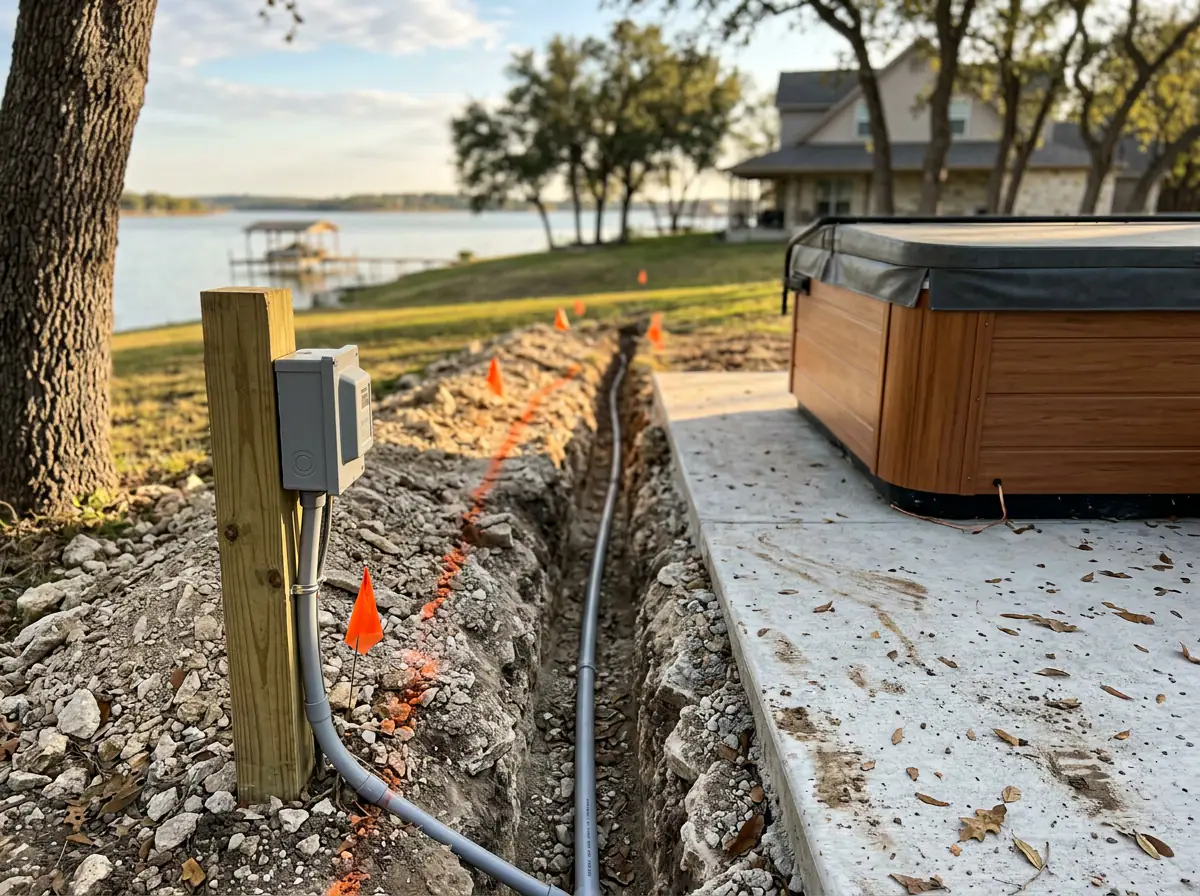
The spa is ordered, the delivery date is on the calendar, and the pad is poured. Then someone asks who is wiring it. This happens more often than you would think, and it leaves a brand new tub sitting full of nothing in the backyard for weeks. Getting hot tub electrical installation in Granbury, TX sorted out before the truck arrives is the single best way to avoid that.
We are Revamped Electric, a veteran-owned electrical contractor based in Granbury. This guide walks Hood County homeowners through the decisions that need to be made first: the circuit, the panel, the disconnect, the bonding, the run from the house, the permit and the timing. It is about planning, not pricing, so you can walk into a conversation with an electrician already knowing what to ask.
Start With the Spec Sheet: Plug-and-Play vs Hardwired Hot Tub
Every decision in a hot tub project traces back to one document: the manufacturer's spec sheet. It lists the voltage, the amperage and the required circuit protection. Your electrician does not guess at the circuit size. The spa tells us what it needs.
Plug-and-play 120V spas
Smaller, entry-level spas often come with a cord and plug and run on 120V. They are simpler to set up, but they are not "plug it into any outlet." They still need a dedicated, properly protected circuit with the right receptacle, and many of them heat slowly or limit how many features can run at once.
Hardwired 240V hot tubs
Larger and more powerful tubs are hardwired to a 240V dedicated circuit. That supports a stronger heater and pumps running together, and it is what most full-size spas on Lake Granbury patios and Hood County acreage use. Common circuit sizes fall in a range that varies by model, which is exactly why the spec sheet matters more than any rule of thumb.
When people compare plug and play hot tub vs hardwired, the real question is not which one is "better." It is which one fits the tub you actually bought. If you are still shopping, send us the model's spec sheet before you buy. A model that needs a larger circuit can change the wiring plan, and it is easier to know that before the purchase. For background on why big appliances get their own line, see our guide on dedicated electrical circuits.
Can Your Panel Handle a 240V Hot Tub Circuit?
A hot tub is a serious electrical load. Before anyone pulls wire, someone needs to look at your panel and answer two questions: is there open breaker space, and is there enough spare capacity on the service?
- Breaker space: A 240V circuit needs a double-pole breaker, which takes two slots. A full panel can mean rearranging circuits or adding a subpanel.
- Panel capacity: Your service size, such as a 100 amp or 200 amp service, and the loads already on it determine whether the tub fits. Central air in a Texas summer, an electric range, a dryer and an EV charger all count.
- Panel condition: An older or recalled panel is not a place to add a new high-demand circuit.
A hot tub does not automatically trigger a panel upgrade. It does when the load calculation says the service is already stretched, or when the panel itself is outdated. We cover what that process looks like in our post on whether your home can handle new appliances, and the warning signs of a tired panel are in our guide to electrical panel upgrades in Granbury. If a panel upgrade is needed, it is much better to learn that now than on delivery day.
The GFCI Spa Disconnect: What It Is and Why Placement Matters
Ask any inspector what they look at first on a spa, and the disconnect is near the top of the list. A hot tub GFCI disconnect is a weatherproof, GFCI-protected switch or breaker enclosure installed near the tub. It does two jobs. It lets anyone cut power to the spa quickly, and it provides ground-fault protection so a fault trips the circuit instead of energizing the water.
The rules come from NEC Article 680, which covers swimming pools, spas and hot tubs. In general, the disconnect has to be readily accessible, within sight of the tub, and installed a minimum distance away from the spa's edge so that someone sitting in the water cannot reach it. The exact requirements depend on the code edition adopted in your area and on the type of spa, so we confirm them for each job rather than rely on memory.
This is why placement is a planning item and not an afterthought. The disconnect location affects:
- Where the conduit run ends
- Whether the spot is reachable but clear of the tub's footprint and any gate or step
- How the equipment looks on your patio
Decide where it goes before you finalize the tub's position on the pad. For more on how ground-fault protection works and where else you need it, read our guide to GFCI and AFCI protection in Granbury.
Spa Electrical Bonding and Grounding Around the Tub
Grounding and bonding are not the same thing, and both matter around water. Grounding gives fault current a path back to the panel. Equipotential bonding ties nearby metal parts together so they stay at the same electrical potential. That includes the spa's metal frame and equipment, and in many cases metal structures, fittings and reinforcing steel near the tub, depending on the installation and code requirements.
The goal of spa electrical bonding is to prevent a voltage difference between two surfaces you could touch at the same time while wet. That is a shock risk you cannot see, and it is the reason this step is never skipped on a proper install. If you want the full picture of how the two systems protect your home, our explainer on electrical grounding and bonding is a good companion read.
Bonding work is also easiest while the pad is still open. If a concrete slab is being poured, tell your electrician early so any bonding components can be placed before the concrete goes in.
Running Power to the Tub on Larger Hood County Lots
This is where lake homes and acreage differ from a typical subdivision lot. The tub may sit on a deck overlooking Lake Granbury, on a patio at the back of a long house, or out near a pavilion well away from the panel. Distance changes the project in a few ways.
Conduit, burial and route
Underground runs have to use an approved wiring method, and burial depth depends on the type of conduit and the conditions, as set out in the NEC tables and local requirements. We do not rely on a one-size number. We confirm the requirement for your specific method and route. What you can do in advance is think about the path: where is the shortest, cleanest route from the panel or a subpanel to the disconnect, and what is in the way?
Things that complicate the route
- Driveways, sidewalks and other hard surfaces that need to be crossed
- Rocky Hood County soil that makes trenching slower
- Sprinkler lines, septic components, water lines and other buried utilities
- Slopes, retaining walls and drainage paths near the lake
Longer runs can also affect wire size, because voltage drop grows with distance. That is another reason the tub's amperage and the route get planned together. For other outdoor power considerations, our posts on outdoor electrical upgrades for Granbury homes and outdoor electrical safety cover the weatherproofing side.
Permits and Inspection for Hot Tub Wiring in Granbury and Hood County
Hot tub wiring is new electrical work, and new electrical work generally needs an electrical permit and inspection. Which office handles it depends on whether your property is inside Granbury city limits or in unincorporated Hood County, so we confirm the right jurisdiction before work starts. If you are in Tolar or Cresson, the same question applies for your location.
On inspection day, expect the inspector to look at the things that matter for safety:
- The disconnect: location, GFCI protection and labeling
- The wiring method and conduit, and in many cases the trench before it is backfilled
- Bonding and grounding connections
- Breaker size matching the spa's nameplate and spec sheet
Your job is simple: make the work accessible and have the spa's spec sheet on hand. Do not backfill a trench or cover connections before the inspection if one is required. Skipping a permit might look like a shortcut, but unpermitted spa wiring can create problems with insurance claims and when you sell the home.
What Drives the Cost of Hot Tub Wiring
Every job is different, and we would rather give you a real quote after seeing the site than a number that does not fit your yard. These are the factors that move the total:
- Distance from the panel: A longer run means more wire, more conduit and more labor.
- Amperage: A larger circuit needs heavier wire and a bigger breaker.
- Panel capacity: If the panel needs a subpanel or an upgrade, that is a separate piece of the project.
- Trenching: Soil, hard surfaces and obstacles change how long digging takes.
- Disconnect and bonding hardware: The equipment required for the installation.
- Permit and inspection: Fees and the time to coordinate them.
The best way to keep surprises off the table is a site visit before delivery. Walk the route with your electrician, and the quote reflects what is actually in the ground and on the wall.
Timeline: When to Book Your Hot Tub Electrician
Here is the order that tends to work best:
- Before you buy, or right after: Share the spec sheet and talk about placement and panel capacity.
- Before the pad is poured: Plan conduit sleeves, bonding and the disconnect location while the ground is still open.
- Before delivery: Run the circuit, set the disconnect and schedule the inspection if it is required.
- After the tub is set: Make the final connection and test the GFCI protection.
Can the wiring happen on delivery day? Sometimes the final hookup can, but only if the circuit and disconnect are already in place and any required inspection is lined up. If the electrical work is not started when the truck backs in, plan for the tub to wait. A good electrician makes sure you are not in that spot. Austin Barrett and Nick Torres put real weight on clear communication and good planning, and a hot tub schedule is exactly where that pays off.
Hot Tub Electrical Installation FAQ
Can I plug a hot tub into an outdoor outlet?
Only if it is a plug-and-play model designed for it, and even then it needs a properly protected dedicated circuit that meets the manufacturer's requirements. A shared outdoor outlet or an extension cord is not a safe setup. Larger 240V tubs cannot be plugged in at all and must be hardwired.
Do I need a permit for hot tub wiring?
In most cases, yes. New spa circuits normally require an electrical permit and inspection, and the office that handles it depends on whether you are in Granbury city limits or elsewhere in Hood County. We confirm that before work begins.
Can you wire it the same day it is delivered?
Possibly the final connection, if the circuit and disconnect are already installed and any required inspection is arranged. Starting from scratch on delivery day is not a good plan. Book the site visit before you set a delivery date.
Do you serve Tolar, Cresson and Weatherford?
Yes. We are based in Granbury and also serve Tolar, Cresson, Weatherford and surrounding communities. If you are searching for a hot tub electrician near me and you are in one of those areas, give us a call.
Get the Power Sorted Before the Spa Truck Shows Up
A hot tub should be the easy, relaxing part of owning a lake or acreage home. The wiring only turns into a headache when it is left for last. Plan it first, and the rest of the project falls into place.
Revamped Electric is a licensed, insured, veteran-owned team that treats your yard like our own. If you want a second set of eyes on your panel, a route for the run, or a straight answer on what your spa needs, we can help with circuit installation and the full hot tub wiring job. Book a hot tub wiring site visit before your delivery date: call us at 817-677-0036 or use our contact page, and have the spa's spec sheet (voltage and amperage) ready.