

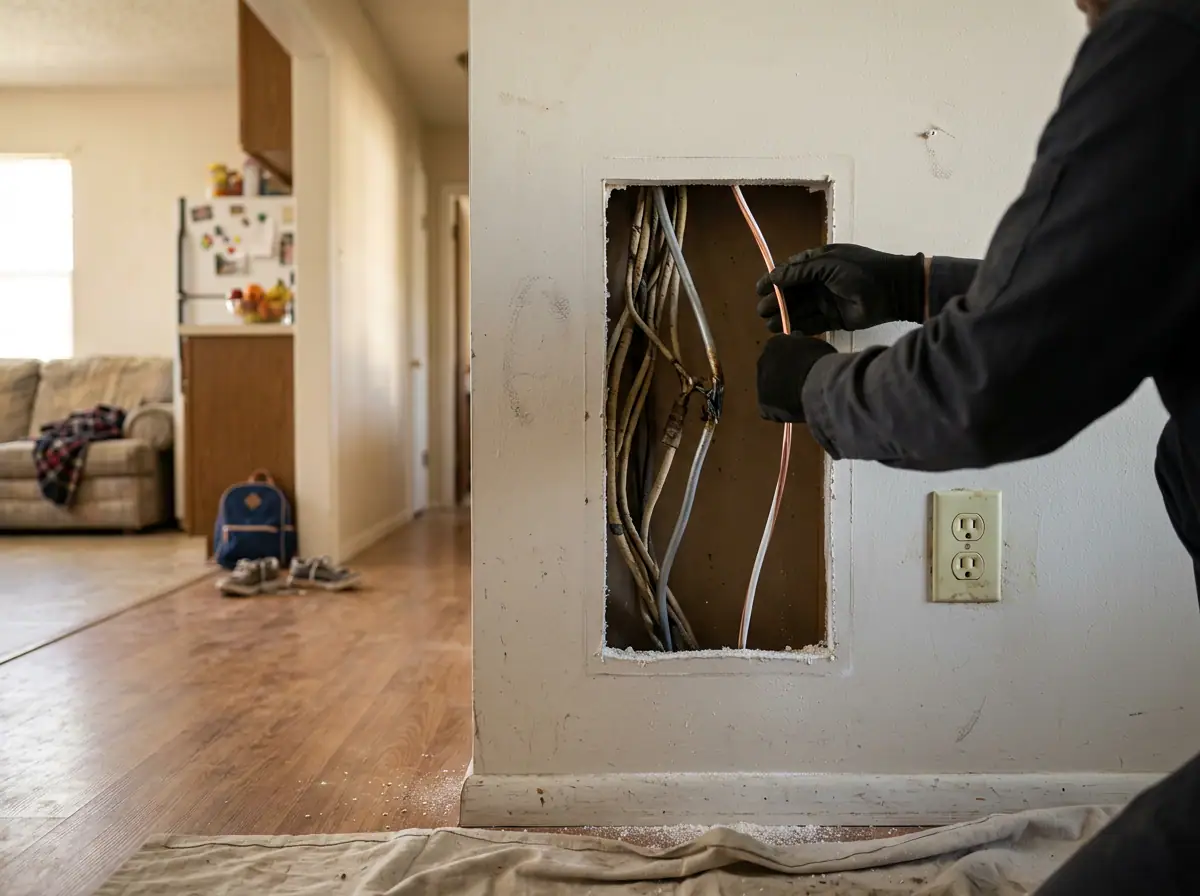
If your home has outlets that run warm, breakers that trip for no clear reason, or wiring nobody can identify, house rewiring in Granbury, TX is probably on your mind. It is also a big decision. Rewiring sounds like opening every wall in the house, and for many homes that is not what is needed at all. Sometimes a full rewire is the right call. Sometimes a partial rewire or a targeted repair solves the real problem for far less disruption.
This guide is for Hood County homeowners who want to make that decision with clear information. We will cover the signs that point toward rewiring, how an electrician decides between a full rewire, a partial rewire and a repair, what the work looks like while your family stays in the house, and what drives the price.
Signs Your House Needs Rewiring
The signs your house needs rewiring usually show up as small annoyances before they become serious problems. None of these automatically means the whole house must be rewired, but each one deserves a professional look.
- Aluminum branch circuit wiring. Some homes built in roughly the mid-1960s to mid-1970s were wired with aluminum instead of copper. It needs special attention at every connection point.
- Cloth-insulated or very old wiring. Cloth-insulated wiring and knob and tube wiring can be found in some of the oldest homes. The insulation breaks down with age and heat.
- Ungrounded two-prong outlets. Two-prong outlets often mean there is no equipment grounding conductor in that circuit, and plugging in three-prong devices with adapters does not fix that.
- Warm outlets or switches. Heat at a device can point to a loose connection or an overloaded circuit.
- Frequent breaker trips. A breaker doing its job is not the problem. The cause behind it might be. If this is happening at your house, our guide on why a circuit breaker keeps tripping walks through a safe first check.
- Scorch marks, buzzing or a burning smell. Treat these as urgent. Turn off the circuit if you can do so safely and call an electrician.
- Past DIY or handyman work. Mixed wire types, loose splices and unprotected junctions are common in homes that have had several owners. Our post on signs of bad electrical work shows what to look for.
For a deeper look at how aging wiring behaves, read our article on older home electrical wiring in Granbury. If your symptoms sound more like a single failing circuit, our overview of faulty wiring warning signs may help you sort out what you are seeing. We also cover this service on our faulty wiring page.
Full Rewire vs Partial Rewire vs Targeted Repair
Whole house rewiring is the most complete option, but it is not the default. The right scope depends on what is actually in your walls, and the only honest way to find out is an inspection.
When a targeted repair is enough
If the problem is a worn receptacle, a loose connection, a failed breaker or one bad circuit, repairing that item is often the right answer. The rest of the wiring may be in sound shape.
When a partial rewire makes sense
A partial rewire replaces the wiring in specific areas or circuits. Common examples include a kitchen and bathrooms that have outgrown their circuits, an addition that was wired poorly, or one section of the house that still has original wiring while the rest was updated. Partial rewires can also be done in phases if you want to spread the work out.
When a whole-house rewire is the better choice
Rewiring an old house from end to end tends to make sense when the wiring type itself is the concern throughout the home, when insulation is brittle or damaged in many places, when there is widespread ungrounded wiring, or when previous alterations have left the system unpredictable. A full rewire gives you a single, consistent, documented system instead of patches on top of patches.
A good electrician will explain which category your home falls into and why, and will not push a bigger job than the findings support. A home electrical inspection is where that conversation starts.
Aluminum Wiring Replacement in Granbury: Your Options
Aluminum wiring gets talked about in alarming terms, and the truth is more practical. Aluminum expands and contracts differently from copper, and over time connections at outlets, switches and fixtures can loosen. Loose connections create heat. That is the concern, and it is why aluminum wiring deserves attention, not panic.
For aluminum wiring replacement in Granbury, homeowners generally have two paths:
- Replacement with copper. This means rewiring the affected circuits with new copper conductors. It is the most thorough fix and removes the aluminum from the system.
- Approved remediation methods. These include COPALUM crimps and AlumiConn connectors, which are designed to make safer connections between aluminum and copper at devices and junctions. Which methods are practical for your home depends on its layout and what the inspection finds.
Neither option is automatically right for every house. Remediation can be a sensible middle path for some homes, while replacement can make more sense when the wiring is in poor condition or you are already opening walls for a remodel. For a full explanation, see our guide to aluminum wiring in older homes.
What the House Rewiring Process Looks Like
Homeowners often picture months of chaos. In reality, a well-run rewire is organized, and you can usually plan around it. Here is the general sequence.
- Inspection. We look at the panel, the visible wiring, outlets, grounding and any past modifications.
- Plan and written quote. You get a scope that explains whether the job is a full rewire, a partial rewire or a repair, along with the price, before work starts.
- Permit. We confirm the permit requirement for your address and handle it as needed.
- Room-by-room work. Work is staged so we can finish areas in order. Attics and crawlspaces are used for routing where possible, which reduces how much of your home has to be opened up.
- Drywall access. Some walls will need small access openings to pull new cable. The goal is to keep these as limited as the layout allows. Drywall repair and paint are typically separate from the electrical scope, so ask about this during the quote.
- Inspection. When an inspection is required, it happens before the walls are closed up and finalized.
- Final walkthrough. We test circuits, label the panel, and walk you through what changed.
Most families are able to stay in the home during this process. We plan which circuits are down on which day so the kitchen, refrigerator and sleeping areas are disrupted as little as possible.
Code Items That Usually Come With a Rewire
A rewire is a chance to bring the home closer to current standards. The National Electrical Code (NEC) sets the baseline, and local requirements can add to it. Here are the items that most often come up:
- Grounding and bonding. New circuits include proper grounding, and the system is checked for correct bonding. Our article on grounding and bonding explains why this matters.
- AFCI and GFCI protection. These protect against arc faults and shock hazards in the locations the code calls for. See our guide to GFCI and AFCI protection for the basics.
- Smoke detector circuits. Interconnected, hardwired smoke alarms are often addressed as part of the scope.
- Dedicated appliance circuits. Kitchens, laundry areas and other high-demand equipment may need their own circuits.
- Panel condition. Whether the electrical panel upgrade question comes up depends on the panel's age, capacity and condition. Some panels need replacement, others do not. Read more about signs your breaker box is overdue for a change or visit our panel changes page.
Many of these upgrades also support fire prevention, which is the real reason most homeowners rewire. Our post on preventing electrical fires covers the risk factors in more detail.
How Much Does It Cost to Rewire a House?
Everyone asks how much it costs to rewire a house, and the honest answer is that it varies widely. We do not quote prices from a blog post, because no two homes are alike. Rewiring is quoted after an inspection, in writing, before any work begins. These are the factors that drive the number:
- Home size. More square footage generally means more wire, more devices and more labor.
- Single story or two story. Routing between floors adds complexity.
- Attic and crawlspace access. Easy access can reduce the amount of wall work. Tight or limited access can increase it.
- Wall finishes. Plaster, tile, paneling and finished drywall all affect how cable can be pulled and what repair work follows.
- Number of circuits. A home with many circuits, or one that needs added circuits for modern use, takes longer.
- Panel condition. If the panel needs to be replaced, that is added to the scope.
- Permit requirements. Permit and inspection steps depend on the address and the scope of work.
A partial rewire or targeted repair will usually cost less than a full rewire, but only an inspection can tell you which one applies to your house.
Permits and Inspections in Granbury and Hood County
Rewiring is the kind of work that typically involves an electrical permit and inspection. Requirements can differ between a property inside Granbury city limits and one in unincorporated Hood County, and they can change. Rather than guess, we confirm the requirement for your address before the work is scheduled. As a TDLR licensed electrician team, we work to code and coordinate any inspections the job requires, so you are not left chasing paperwork.
One Accountable Crew, Not a Call Center
Revamped Electric is a small, veteran-owned team based in Granbury. Austin Barrett, our veteran owner and a U.S. Navy veteran who served aboard the USS Jason Dunham, leads the work. Nick Torres, co-owner and a Granbury native, focuses on new construction and residential service calls. When you call, you reach the people who will be in your home. Learn more about us on our about page.
If you have been searching for an electrician to rewire your house near you, we serve Granbury, Tolar, Stephenville, Cresson and Weatherford, along with the surrounding communities.
House Rewiring FAQ
Can I stay in my home during a rewire?
In most cases, yes. Work is planned room by room and circuit by circuit so that power is restored at the end of each day wherever possible. We will talk through your schedule, including anyone who works from home or has medical equipment, before the job begins.
Does homeowners insurance care about aluminum or old wiring?
It can. Some insurers ask about wiring type, panel brand or home age, and policies vary by company. We cannot speak for your carrier, so check with your insurance agent. A written inspection report or documentation of remediation can be helpful to have on hand.
Do I need a new panel?
Not always. A panel upgrade depends on the panel's condition, capacity and brand, and on how much load your home needs. We evaluate it during the inspection and tell you plainly whether it is needed.
How do I know if my house was rewired before?
Clues include modern cable with printed markings, grounded three-prong outlets throughout, a newer panel and permit records for the address. Older homes often have a mix, with some areas updated and others original. An electrician can confirm what is in the walls and attic.
Find Out What Your Home Actually Needs
You do not have to decide on a full rewire before you pick up the phone. A wiring inspection from Revamped Electric tells you whether your home needs a full rewire, a partial rewire or a simple repair, and you receive a written quote before any work starts. Call us at 817-677-0036 or use our contact page to book your inspection.